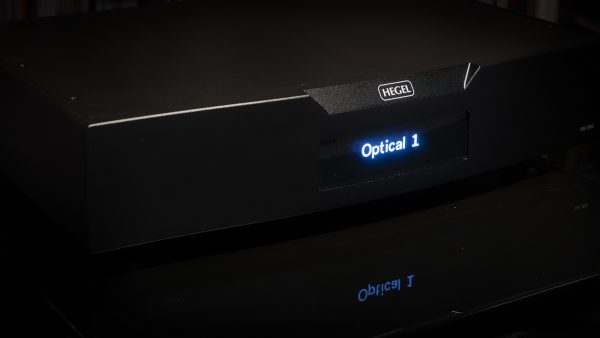
What would you play first if you had the dCS Varèse plugged into your system? It had to be Chicago’s “Hit by Varèse,” from Chicago V. Sorry, no flute music here. Why use a track that many audiophiles would consider off the path? The explosiveness of the horns on a cut I’ve been listening to for decades, honestly, tells me everything I need to know instantly. This was going to be a wild ride indeed. Six months later, it still is. Every single time I listen to the Varèse, I’m as excited about it as I was in the first 15 seconds I heard it. That’s kinda rare.
With anything. It’s often easy to assimilate even quantum leaps in performance quickly making them the new normal, forgetting what came before. Not this time.
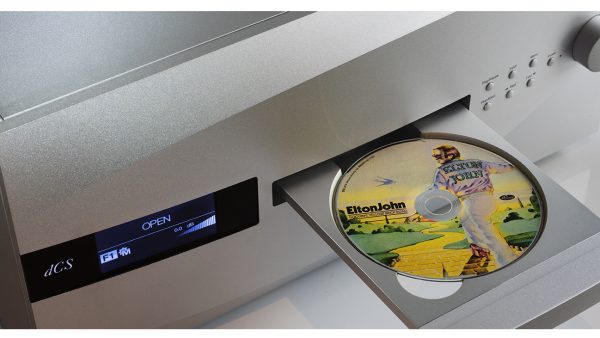
Shiny discs remain a viable means to listen to music here; the transport option for the Varèse is a welcome addition. Of course, you could get the optional interface board (which our review sample has) and use a lower-capacity transport mechanism if you have a smaller collection, but if you’ve come this far, why not have everything match? I apologize, it’s always easy to spend your money.
With so many people on YouTube crying foul play on a digital music player costing this much, why write a review of this product? Even within the TONE readership, it’s a bit beyond what most would choose, though a healthy number of our audience are dCS owners, with more Vivaldis than you might expect.
The reasons for exploring this flagship product are primarily selfish, and here’s why. Years ago, an acquaintance offered me the keys to his then-new Ferrari F50. I politely refused, telling him, “I can’t ever have this, so I’d rather not know.”
I’ve regretted saying that more days than you can imagine. As Stirling Archer would say, “Why would you not?”
 This time I took the keys with pleasure. The next track up is “Keys to Her Ferrari” by Thomas Dolby. If you’re waiting for my comments on Patricia Barber or Diana Krall, it’s not gonna happen. However, if you are a female vocal or acoustic instrument lover, you’ll be taken aback by the rock-solid pitch stability the Varèse offers.
Though I’ve had a nearly 20-year relationship with dCS, and have owned my past two dCS players as reference components (a four-box Paganini stack, and my current reference, the Vivaldi ONE/Apex), I was suffering a bit of expectation bias with the Varèse. Not the bias you might expect. I thought it might just be an exercise in self-indulgence on their part. I couldn’t have been more wrong.
With the high-end taking so much flak for being overpriced, I was a little nervous unboxing all this stuff. All the past dCS DACs I’ve used usually need at least an hour or so for the electronics to completely stabilize thermally and electrically – and the Varèse is no different. But 3 seconds into that Chicago track, this was well beyond anything I’ve heard from digital. The next day, after playing nonstop for 24 hours, it opened up quite a bit more. It hasn’t been powered down since that day.
The better news is that, six months later, my enthusiasm for the Varèse has only grown. Like the Magic Bus, I want it, I want it. But $300k + on a digital music player at this point in my life doesn’t make sense.
If I were in my late 40s-mid 50s and knew I still had at least 20-30 years of canine hearing left, I’d be at the bank signing papers for a HELOC right now. I’m telling you this now to frustrate those who only read the last paragraph of a review. This is my conclusion, baby.
I’m not kidding. It’s that good. I couldn’t have been more wrong. The level of performance and musical reality that Varèse brings is straight up from where Vivaldi is.
As good as the Vivaldi ONE/Apex is, this is another level. It’s like going from a 911S to a GT3RSR. On one hand, you jump back in your standard Carrera, thinking “this isn’t so bad, it’s not really 1/3 the car.” But then you get back in the GT3 and listen to that engine shriek as it hits 9,000 rpm. On one hand, it might not be worth 3x, (to you) but on the other, you can’t get this level of performance any other way – so at that point it’s priceless. Seriously, you could spend more than this on a turntable these days.
Much like turntables and cartridges at that level, the best digital products go to a point of resolution, detail retrieval, dynamic range, and lack of sonic signature that they truly disappear from your thought process as you experience them.
That’s what Varèse does. Pages of flowery prose comparing this thing to the world’s best everything still doesn’t tell the story. Having been promised “perfect sound forever” for a very long time, this system certainly delivers on that promise.
It’s still different than vinyl
Comparing great pressings of similar albums is still somewhat of an apples-to-oranges proposition. There are times the digital platform reveals more music, and others, the nod goes to analog. My favorite comparison is that of an image shot on the world’s most resolving digital camera and an equally excellent film camera. The digital camera provides an image that is crisper, with wider dynamic range, and truer color – for some pictures, this rendition suits them better, while the more compressed, embellished, saturated delivery of analog can be more intriguing. After decades of arguing about analog vs. digital, I submit it’s more about perspective than sheer ability at this point.
Years ago, when I stepped up to a dCS player, I stopped saying, “It sounds good for digital.” The two formats have happily co-existed in my system ever since.
In Quintessence
Originally, I was going to experience the Varèse’s awesomeness at Quintessence Audio in Morton Grove, Illinois – thanks to their always hospitable owner, Mick Survence. It was not to be; my mild case of dyslexia thwarted that.
On the Friday of the event, I received a phone call from David Steven, director of dCS: “What time are you planning on being out for the event?”
“Umm, next Friday at 7pm, dude.”
“It’s this Friday, mate.”
“Uh oh.”
Fortunately, he laughed at me and said, “Well, we’ve all done that, haven’t we?”
So, a couple of weeks later, LMC Audio in Scottsdale, Arizona, was hosting the next Varèse event, and the equally affable owner, Mike Ware, let me join the party. Steven was there to present, and we all had a good laugh at my expense. A few days earlier, he did check up on me – “got the date right this time?” Busted.
The Varèse made an incredible showing paired with not one but two multi-million-dollar systems – one based on Wilson Audio and D’Agostino, the other Sonus faber and Burmester. At this level of excellence, it’s tough to tell the delta without truly hearing it in the context of your reference. Suffice to say, everything digital was a letdown at the Florida HiFi Expo the following day.
Someone else’s bell
As there have been a couple of in-depth, back-and-forth conversations about all the fine details of the techie side of the Varèse system, I’m going to send you to Stereophile. Click the link here to read Jason Victor Serinus’ point-by-point of the tech minutiae.
This is going to be more of an experiential review of what it’s like to live with a product delivering this level of performance, what it’s like, and how it’s altered my thoughts on what digital can really deliver.
To say the Varèse was the high point of my year last year (2025) would be the understatement of a lifetime. However, it didn’t start with all six boxes because the transport hadn’t yet been released. At this point, the Varèse in my system was still sans transport.
The component parts
In addition to the CD/SACD disc transport, the Varèse system consists of the core (the largest box) that handles housekeeping functions, streaming services, and processing required before feeding the mono DACs. (I’m guessing this means upsampling, should you choose to go this route)
 The mono DACs have two sets of balanced XLR outputs and two pairs of RCA outputs. I’ve been cheating, using the balanced outputs for my main system, and running a 5m pair of interconnects to system two. Like my Vivaldi, being able to serve music up through two systems really provides more value as a review tool, to be sure.
The master clock connects via the same bus, and finally, the system controller. Both iOS and Android can be used to control the system externally with the dCS app, should you choose to use it. The master clock is an additional $39,995, as is the transport, so ideally you could get into an “entry level” Varèse for about $215,000. Crazy, eh? Makes me think about going for it…
As with every other great digital setup I’ve used (dCS or not) that supports a master clock, the Varèse takes it to another level. The effect is the same. You might think those 1’s and 0’s aren’t all that important, but how they arrive at the DAC is. The more accurately this is handled, the cleaner, bigger, and broader the music sounds.
dCS went back to the drawing board for every aspect of the Varèse. Their legendary Ring DAC, which is all software-driven, is now a dual-differential Ring DAC, massively overbuilt, with future processing headroom built in for expansion at some point. In addition to the advances in their raw DAC technology and the ACTUS bus/cables, their new Tomix technology enables those mono DACs to operate in complete synchronization.
Add all the small increases in performance, everywhere – both in the mechanical and electrical domains, and you have a digital music system that delivers a breathtaking experience.
A snap to set up
Arriving in a monstrous stack of wheeled Pelican Cases, the Varèse is incredibly easy to set up and start playing music. Having cleared a shelf on my bespoke Quadraspire rack for the dual DAC modules and acquiring another for the other four components (yes, the transport was on its way), nothing proved too heavy to lift and move by myself. At 73 pounds, it’s a touch heavier than my Vivaldi ONE/Apex, but it’s not Pass monoblock heavy. The other pieces weigh about 32 to 44 pounds each. Easily a one-person job, just make sure you have the rack space. Seriously, the Varèse took about five minutes to put in the rack, and another five to connect it up.
Where the full Vivaldi four-box stack needed about a dozen separate digital cables to interconnect them, the Varèse uses five if you use the transport. The four-box Vivaldi architecture required a fair amount of daisy-chaining components together and running separate clock cables back and forth. Vivaldi featured a DAC, clock, upsampler, and transport, all as separate components.

Varèse uses a central core, a pair of mono DACs, a master clock, and a user interface, all separate. And of course, the transport, should you decide to take that route. I suggest you do.
The secret is their new ACTUS bus, which connects everything. In the past, with digital cables and clock cables, even with dCS’ concise instructions, I’d be lying if I said I haven’t set one up wrong on the first go. ACTUS eliminates all of that. With Varèse, everything plugs directly into the CORE (the large box)

Varèse only requires you to pay attention to one of the 8 sockets on the rear panel, the one marked “clock.” As long as you get that one right, the other 4 or 5 cables can be plugged into any socket, in any order. dCS utilizes a special set of LEMO connectors for the ACTUS cables designed specifically for dCS and the bandwidth required. You can read more about that on their website here. Everything clicks together in a positive manner, exactly like connecting a power supply to a Nagra piece – they are the same connectors functionally, though the ones custom-designed for dCS go further in terms of electrical and mechanical performance.
If you don’t read the manual, a difference with this dCS is the Bluetooth antenna. Crazy as it sounds, you can stream from your phone with Spotify. Upsampling to DSD, the rubbish bit stream sounds damn good. Back when iPods took advantage of exporting the digital bitstream to USB, I used to demo 128kb/sec files from my iPod through the four-box Vivaldi, and people were shocked at the playback quality. The Varèse does an equally stunning job with Bluetooth playback – though you’ll probably never use it. But to be clear, the Bluetooth antenna is only for the remote. Spotify streaming goes over the network input.
What you will need it for is to link to the Coolio, round, backlit remote. Oh yeah. dCS, REL, and Devialet all get my vote for the sexiest, easiest-to-use, smoothest-feeling remotes. Come on, you don’t want a kids’ meal remote with your $300k player, do you? Or you can download the new dCS Mosaic ACTUS app from the web.
At present, there are no third-party cables for the Varèse, but dCS claims that said cables will have to meet a certain quality standard to be used, should they ever arrive. That said, I did hit the folks up at Cardas for a set of six Clear Beyond XL power cords to use for the duration of the review. Ed. note: In the time between our review being finished and now, you CAN get some ACTUS cables from Transparent at about $10k each. You can learn more about the ACTUS bus/cables here….
With a Cardas power strip already on hand, the Varèse system got its own, dedicated 20-amp circuit, to minimize noise and interaction with the rest of my system. At this point, why leave anything to chance, right?

Even with the optional Digital I/O module, setup is still incredibly easy. It features single- and dual-AES inputs for another source, and a BNC clock output. Should you want to use an existing Vivaldi or Paganini transport, you can do so and keep everything in sync with the master clock.
Once connected, pressing the small buttons at the bottom of the casework starts the system up. About two to three minutes later, the small LEDs on the front panel turn from purple to white, and the display comes alive.
If you are using the Varèse inside a Roon ecosystem, setup is immediate. Merely going to the Audio section of the settings menu will show the Varèse in the “ROON Ready” column. Click “enable,” and you’re rocking.
A quick test
The I/O module makes it easy to hear the difference the Varèse transport makes in overall system resolution. dCS has made an incredible effort to isolate the transport mechanism from the case, both mechanically and electronically – delivering a level of clarity I’ve never heard before.
Using the transports on hand from Metronome, Advance Paris, Sony, and a vintage Proceed, quickly show off how much more fine detail resolution and image size in all three directions the Varese transport extracts from the discs. There’s more to this than just 1s and 0s. Perhaps before the Varese has to go back, we can get our hands on a Paganini transport, so something in the 10-20k range to see how it works. Again, those not having such a massive disc collection might welcome this as a transport option.
The art of noise cancellation
A big part of the sheer clarity the Varèse provides comes down to an F1-level attention to the minutest electronic and mechanical details. As their field guy, Andrew Szelke tells me on his visit, “Every single hole in the casework is a place for RFI and noise to enter or escape.” Examining every surface and corner reveals none. Only the rear panel reveals any fasteners at all. Just this aspect of the Varèse required a massive amount of mechanical engineering chops.
Every aspect of Varèse was examined to keep every kind of noise to the lowest possible levels. I am convinced that this level of obsession everywhere is what gives this player such a huge sonic footprint.
Even the user interface display was questioned. Instead of the TFT screens that everyone else uses, this is an insanely high-quality LCD panel. Again, lower noise was the main reason for choosing this part, albeit at a much higher cost.
The dual mono DACs are a big part of the Varèse’s lack of sonic signature, and dCS claims that the two individual mono chassis are matched to within 1 ppm in digital accuracy. Again, Steven goes on to tell me just how much time and work went into achieving that level of accuracy. “That’s a big part of what gives the Varèse its magic.”
Spinning discs
I can’t tell you why, but playing the disc versus merely streaming a track (hi-rez or not) always reveals more spatial information. For example, comparing the 24/192 file from Qobuz or Tidal to even the standard CD of Shelby Lynne’s Just a Little Lovin’ recording, the 16/44 disc wins hands down, and the SACD produced by Analogue Productions even more so.
With thousands of discs still at my disposal, a disproportionate amount of time playing my favorite tracks on disc proves more engaging when available. If the Varèse makes you new to the compact disc and SACD thing, you will probably end up searching out certain, oftentimes more original discs rather than relatively current remasters that tend to be more compressed and brightened up. Don’t overlook early Japanese CD’s and early “target” CD pressings. Often, these were much closer to the master tapes than later editions.
MoFi, Acoustic Sounds, and Impex – among others are still firmly committed to producing SACDs, so even if you don’t have a collection and would like to start, there are plenty of discs at your disposal.
Roon and everywhere else
Counterintuitive though it may be, listening to a fairly long playlist of music that I know sounds terrible from a production standpoint further shows off the sheer ability of the Varèse. And this is another argument amongst the internet pundits – with so many bad recordings, why invest in a playback system like this?
Yes, the worst recordings you love still sound worse than the best recordings in your collection. The way the Varèse unpacks even the most two-dimensional, compressed recordings (both via disk and streaming) is more stunning than even what it does with pristine recordings.

Dwelling on minor details in recordings that don’t matter to you, what makes the Varèse such a wonder is how much further it takes every aspect of musical performance. While I can’t hear the difference in noise floor between the Vivaldi ONE and the Varèse, I can hear the increased dynamics everywhere. There is also considerably more low-level detail and decay, which I never really noticed until going back and forth between the players. This results in a richer musical tone and texture throughout.
Superlatives and cliches aside, in my long experience with high-performance digital, the Varèse presses the boundaries of component invisibility further than anything I’ve experienced. That’s the highest compliment I can pay it. Not only is it completely devoid of any digital or electronic signature, the sound field rendered in the context of my reference system is enormous in all dimensions, almost as if I were listening to surround or Atmos, but I’m only listening to the front speakers (with the six-pack of REL subs).
In addition to the gains in dynamics and the ability to create a three-dimensional space, the Varese serves up a ton of texture and musical detail. All of the timbre-related cues that fool you into thinking you’re hearing real instruments between the speakers are here in spades, too. I’ve heard more than my share of harsh, overly etched phono cartridges that don’t sound this natural.
Tempted by the fruit of another (format)
I’m going to come right out and say it. Much as I love turntables and vinyl, I could live without analog if I had a Varese. And I say that after decades of turntable setup, and record cleaning, I’m seriously considering selling my seven turntables, three phono preamps, and 5,000+ record collection, and calling it a day. If for no other reason, simplicity in my old age.
Considering what records cost today, many of you already have the cost of a Varèse tied up in vinyl. It’s blasphemous, I know, to suggest such a radical shift in your audiophile life (and I probably won’t be able to do it either), but in terms of rationalizations, getting your hands on a Varèse isn’t as outright crazy as you might think.
I get it, this is a very expensive player, that is probably out of reach of most of us, myself included. However, in a never-ending collection of data points, from $100 to the $300k+ of the Varèse, this has been an exciting exercise. And it’s rare that I don’t buy $500-$600 worth of records every month. Maybe…
Totally worth it
That said, I won’t minimize how great this player is, just because I can’t afford one. You can’t get what the Varèse does in a budget player, and should you pick one of the other top players from Esoteric, MSB, or Wadax, you’re looking at spending the same amount or even more.
I think it’s fun knowing that stuff like this exists, and people go to work every day trying to figure out how to push the envelope further, all the time. As David Steven winds up our Zoom call, he makes it very clear that Varèse took years to implement. He smiles, saying, “halfway in, after we’d spent millions of dollars on R&D and prototyping, we still weren’t completely sure.” According to Steven, a lot of the final bits on Varèse were worked out, producing their newer compact DAC, the LINA. TONE staffer Chris Harr has a LINA stack, so we were able to compare there as well. “On one level, the Lina has more in common with the Varèse than the Vivaldi does.”
To the people in the audience who can easily afford the Varèse, or perhaps are stepping up from a Vivaldi, I think you will be surprised that dCS is able to make such a massive leap in performance, and I’m assuming you’ve got the room, system, and music collection to easily hear it. With two or three remaining free slots on the rear panel (depending on whether you get the I/O board), dCS will no doubt have more in mind for the Varèse. This is a major point in favor of investing in a dCS music system. They offer a steady stream of hardware and software updates to keep your player up to date for years after you purchase it.
The only thing the Varese doesn’t do is display album art and track info when playing a music CD. It’s all good when streaming. Knowing the folks at dCS, I wouldn’t be the least bit surprised if this shows up sooner than later in a future firmware upgrade.
I’ve owned my Vivaldi ONE for almost 8 years now, and with an APEX update and the latest firmware, it’s a new machine again. An important thing to consider when spending this much money. It’s also worth mentioning that in over 15 years of using dCS players as my digital reference – being powered up 24/7, nothing has ever failed. For that matter, none of the people I know who own a dCS product have had issues yet.
This is the longest review I’ve written in nearly 25 years of writing about audio – but the dCS Varèse is the most elaborate component I’ve ever spent time with. I still feel, after nearly 4,000 words, I haven’t told you enough. It’s also the most amazing component I’ve ever experienced. I truly can’t imagine pulling more information from those 1s and 0s.
If you’re the person who skips to the end, thirty seconds of listening will tell you more than this review. You’ll know the minute you press play on a well-known track. And if I were a younger man, I’d be lining up to order one myself. HELOC rates be damned.
The dCS Varèse – six box stack with SACD/CD transport
$305,000 (approx.)
Peripherals
Preamplifier Pass Labs XS Pre and XS Pre2
Power Amplifier Pass Labs XS300 monoblocks
Speakers Clarisys Auditorium Plus with six pack of REL Carbon Special subs
Cable Cardas Clear and Clear beyond
Racks Quadraspire