How could I not begin my listening to the Albedo Achema speakers with something Italian?
Zipping through Cinema Italiano, a new interpretation of Italian film music, the vibe felt like I was back on the island of Lido, walking down the street, sipping a cappuccino, and watching the Vespas zoom past. Mmmmm. Even right out of the box, these speakers sound big and open; however, past experience with ceramic cone drivers suggests a careful break-in period. Where I might break in a pair of someone else’s speakers blasting hip-hop or Slayer at close to maximum volume, the Adagias get a hundred hours of Italian opera at modest volume before I get down to serious listening.

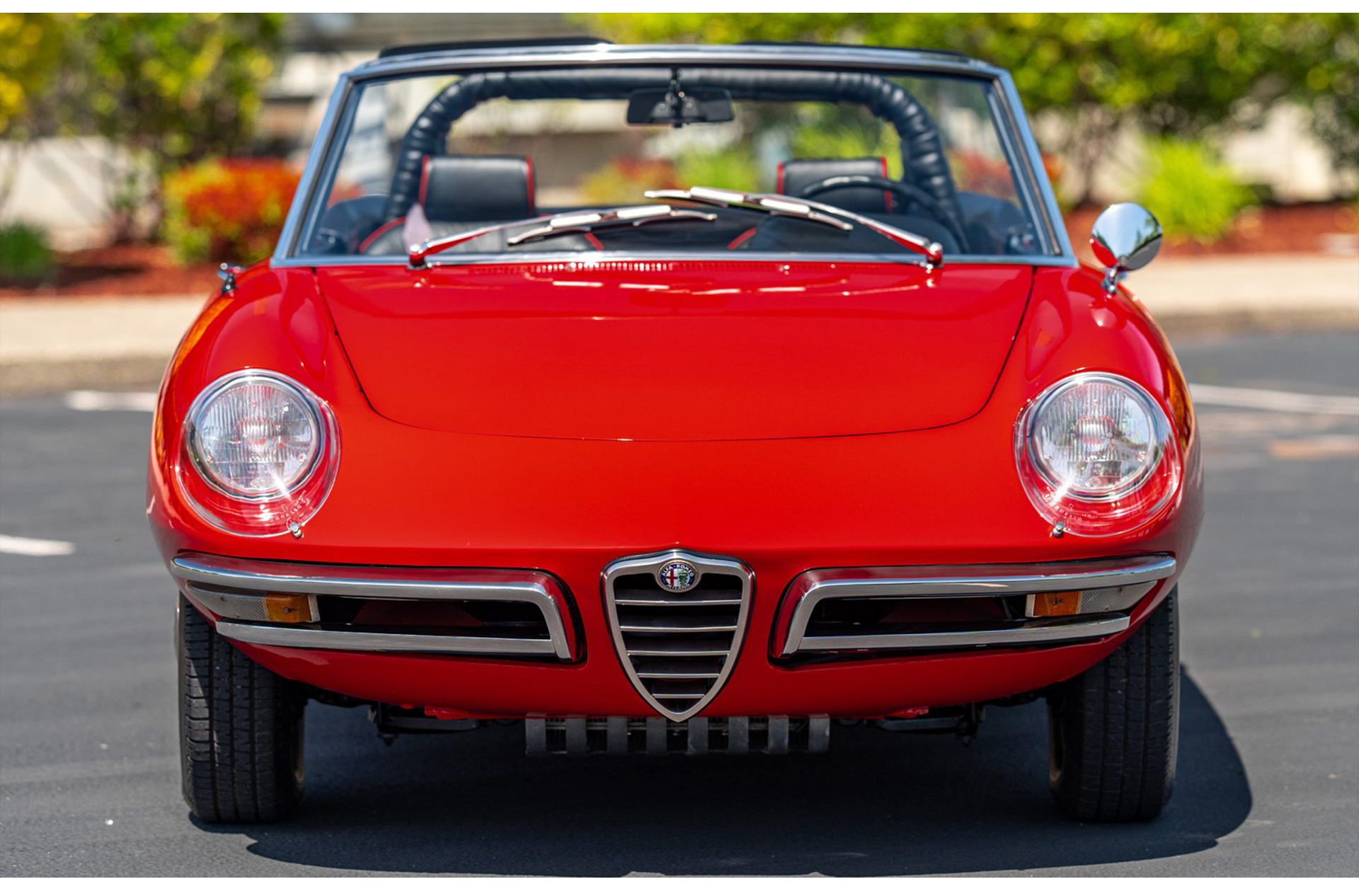
Out in the garage, flanked by my two Alfa Romeos, the shiny Italian thing was going on big time. The attention to detail, smoothness of the finish, and the overall high level of craftsmanship can not be ignored. Grey may not be for you, but it’s a color I’ve come to appreciate. The semi-dark shade of high-gloss grey is so sumptuous that I’m thinking about asking the folks at Albedo for the paint code. My silver ’79 Spider Veloce is in desperate need of a respray next spring, and I’m thinking this grey with the burgundy leather seats would be che figata. Sorry for getting off track.Like automobiles, speakers can’t just be a thing of beauty; they must perform. While these speakers do just that, Albedo Audio has done a few interesting things to make them easy to integrate into your music system.
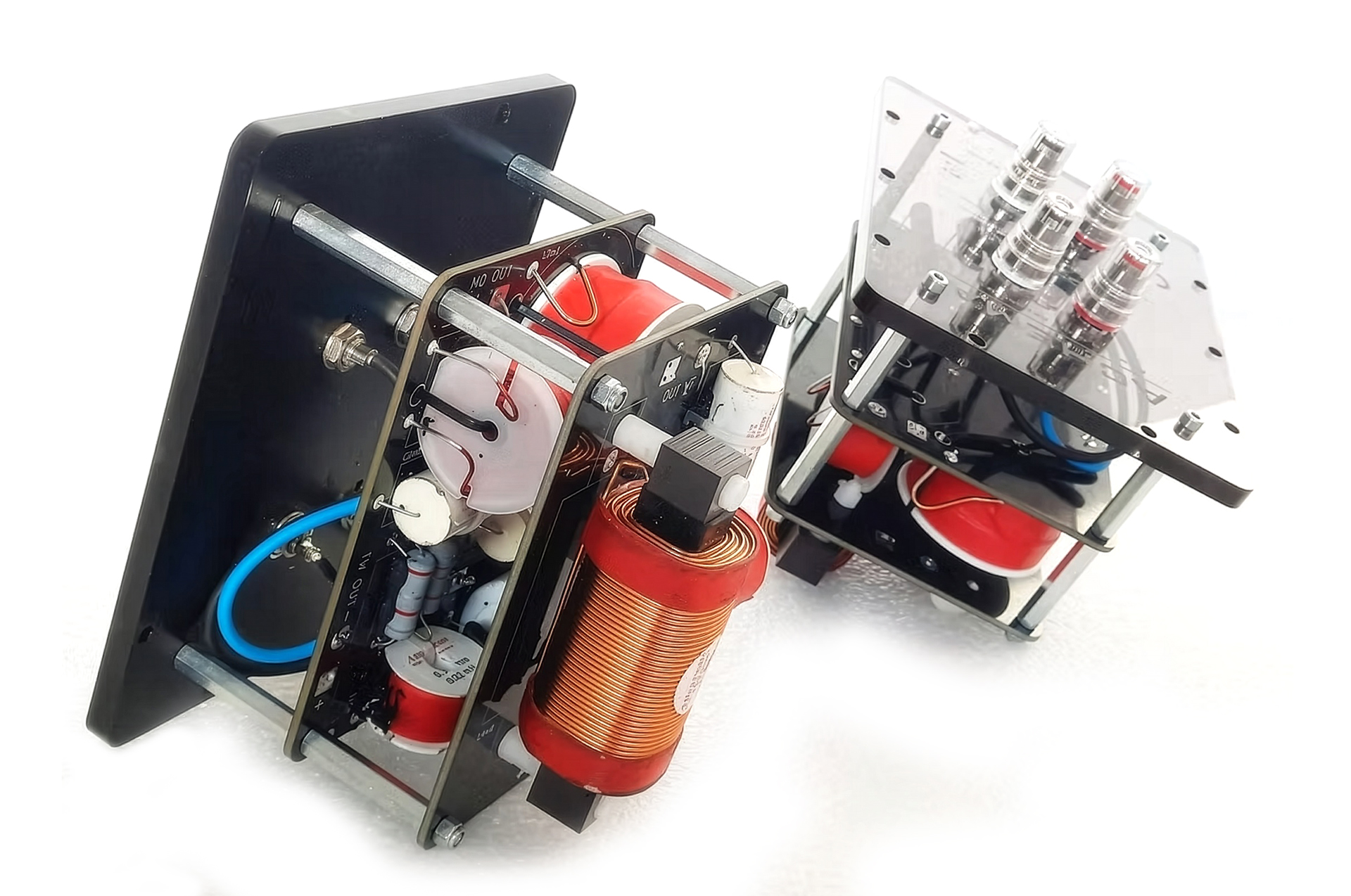
You can click here to visit the website and learn about the hand-wired crossover network, including the inductors and Mundorf capacitors, as well as the components that go into the cabinet and feet. No need to spend half the review repeating the spec sheet.
However, the most exciting thing to me is that these speakers have a nominal impedance of 11 ohms. This is awesome because it makes these speakers incredibly tube amplifier friendly. With many of today’s speakers having a nominal impedance of 4-6 ohms, often dipping well below this at specific frequencies, they can have a tendency to sound strident or bass-shy with some amplifiers. The Achemas do not suffer from this at all.
In addition to their friendly impedance curve, the woofer is placed in a transmission line enclosure, with the ports out to the lower sides. This makes for a smoother bass response, and gives you a wider range of placement options that a speaker with a down-firing port, or a rear firing port.
After trying the Achemas with about a dozen different amplifiers, tube and solid-state from Pass, Luxman, CH Precision, PrimaLuna, ampsandsound, and a few others, you can rest assured that the Achemas will deliver a stunning performance with whatever you have in your system, provided you have at least 30 watts per channel. Of course, room size and how loud you need to listen will determine whether you need a lot more power or not.
Set up and caution
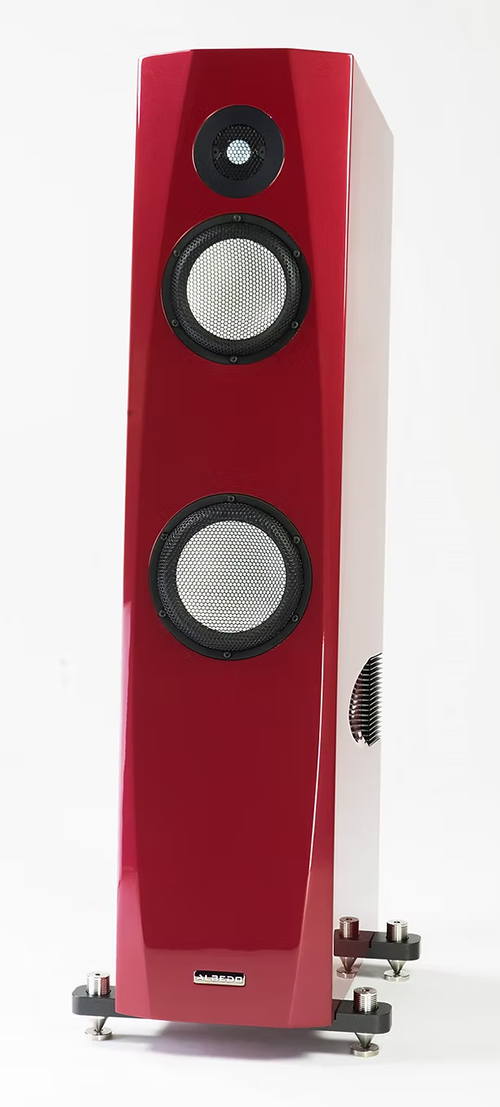
Let’s address the most important thing first. This 2 ½-way speaker system uses a 1-inch ceramic tweeter, a 6-inch ceramic midrange, and a 7-inch ceramic woofer. In case you aren’t familiar with ceramic drivers, they are incredibly low in distortion and costly compared to other drivers.
Now for a word of caution. Because these speakers are so free of distortion, they do not flatten out in the same way that drivers with traditional materials do. If you’re someone who likes their music really loud, I advise caution, because there is no warning as you approach the danger (I.e., driver-damaging) volume level. Most dynamic driver speakers have a margin where they flatten out from a dimensional standpoint, right before clipping sets in. Ceramic drivers play clean right up to the point of damage. I have seen more than one overly enthusiastic audiophile destroy speakers with these drivers. The ceramic cones disintegrate into pieces like a broken plate.
So, there will be no “I don’t know what happened, I was just playing Chuck Mangione really soft and then this happened.” You’ve been warned. I know. Adult decisions.
That said, these are positively lovely speakers. Though Albedo says these are 84 pounds each, they did not feel that heavy when positioning them in my 24 x 36-foot listening room on the 24-foot wall. They fell into place relatively close to where most speakers sound great in my room – about 10 feet apart, about 8 feet from the side walls, and about 4 feet out in the room. The ceramic tweeter is slightly more directional than one with a soft dome, but not nearly as much as a panel speaker or one featuring a ribbon tweeter.
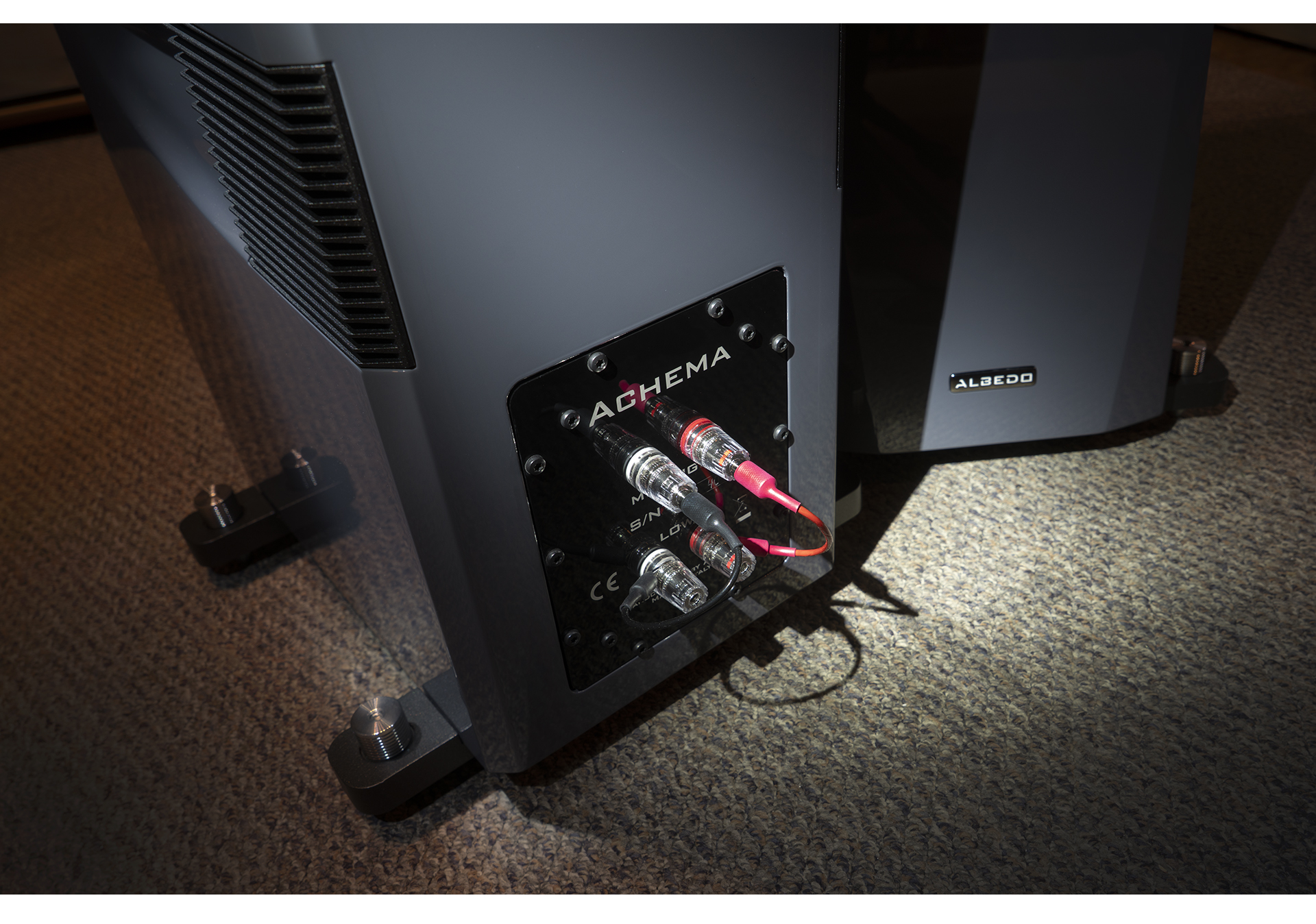
Get a friend and take advantage of the beautifully crafted, threaded feet to set the rake angle perfectly. Start flat and optimize the Achemas to the best of your ability for maximum soundstage width and depth, along with the best balance of low to mid-bass. Again, thanks to the high resolution these speakers deliver, this is easy to do, because it’s relatively easy to hear when you hit the sweet spot. Just before you begin experimenting with rake, lift your head up and down slowly, listening for the spot where the image really blooms. Make a couple of big adjustments to get closer, then, a quarter to half turn of the feet will bring you to perfection.
A brief stint in my 13 x 18 foot living room with an 8-foot ceiling and wood floors makes for a slightly more challenging time getting the mid bass balance just right (though I have this problem with a lot of speakers in this room), so if you have a small-ish room, plan on spending an extra 30-60 minutes fine-tuning. The extra effort is worth it – while the Achemas don’t have quite as expansive a presentation in a smaller room, they create a bigger sense of depth and immediacy. A bit of room gain, taken to your advantage, also gives them the illusion of sounding like a much bigger speaker than they are. If you can’t place them a few feet out from the rear and side walls due to living constraints, you can slightly dampen the first reflection from the side of the speakers with a bit of room treatment – that will also aid in a larger soundfield for your enjoyment.
 Amplification
The Achemas have an 85db/1-watt sensitivity rating, yet are super easy to drive. Even my modest PrimaLuna EVO 100 delivers excellent results and more than enough volume. Stepping the game up to the Canor Virtus I2 provides more detail everywhere, and great bass control. The 11-ohm impedance makes for a great match with your favorite tube amplifier.
Moving on to the PrimaLuna EVO 400 monoblocks with KT150 tubes yields a serious upgrade in sonic performance, especially with the 16-ohm tap. If you have an amplifier with a 16-ohm tap, I highly recommend trying that. With the EVO400s, I’m usually switching between the 4- and 8-ohm taps, trying to get the best balance of bass control and dynamics. However, here, it’s definitely with the 16-ohm tap.
Switching to solid-state power and integrating the Achemas into my main system with the massive Pass Labs XA600.8 monoblocks yields an entirely different presentation. Where the tube amplifiers deliver a more liquid presentation, the huge class AB amplifiers are more resolving and produce bigger, tighter bass response, the Pass XS300 full class A amplifiers are the best of both worlds.
These speakers deliver a neutral overall presentation; the amplifier you choose (and, secondarily, the cables) will determine what you get out of them. This gives you more system options than a speaker that is voiced more towards the warm or overly detailed side.
More listening
While Albedo claims a low frequency point of 44Hz without a dB spec, some test tones indicate solid bass down to 40 Hz, so nothing musically is off limits. Again, remember those ceramic woofers, when you want to blast hip-hop at club levels, and it’s all good.
Because of their freedom from distortion and clarity, these speakers excel at unraveling densely packed music. And because they do this so well, they will make a number of your favorite albums that might have been a little bit unlistenable and dense a lot more intriguing. This is my favorite aspect of these speakers. Ella sounds great, but so does Patti Smith. Not all speakers can do this.
Bouncing back and forth between the Achemas and my Quad 63s, as well as the single-driver Songer S1s, I’m constantly excited about the way these speakers feature an excellent crossover design that blends the three drivers so smoothly. As I’ve mentioned in the past, one of the most challenging aspects for a speaker to master is reproducing male and female voices with equal ability.
Another aspect of these speakers, again in part to the ceramic drivers, is their overall speed and quick transient response. Drums and cymbals are clear, clean, and defined, with amazing decay. How far you want to take this will depend on your associated components and just how much detail you crave. I’m biased towards a warmer sound, and I prefer these speakers with tubes. However, even with a highly resolving amplifier like the CH, the Achemas deliver a highly resolving musical picture without going too far and becoming harsh, grainy, or fatiguing. It’s a very cool, engaging experience that might have you plunking down the credit card for a pair.
If you’ve ever wanted nearly all the speed and transparency of a panel speaker in a box-speaker form factor, these could be your grail speaker. If grey isn’t your color, the Achemas are also available in high gloss black and red. My inner Alfisti wants a red pair for the garage! Crazy.
We look forward to sampling a few more speakers from this fine Italian company in the future. Well done. -Jeff Dorgay
$16,500/pair
albedoaudio.com (Manufacturer)
supremeacousticsystems.com (US distributor)
Peripherals
Digital Source dCS Vivaldi One
Analog Source SME 20 table/Hana Umami Red
Preamplifier Pass Labs XS PRE
Phono Stage Pass XP-27
Power Amplifiers Pass XS 300, Pass X600.8 PrimaLuna EVO400
Cable Cardas Clear, Clear Beyond