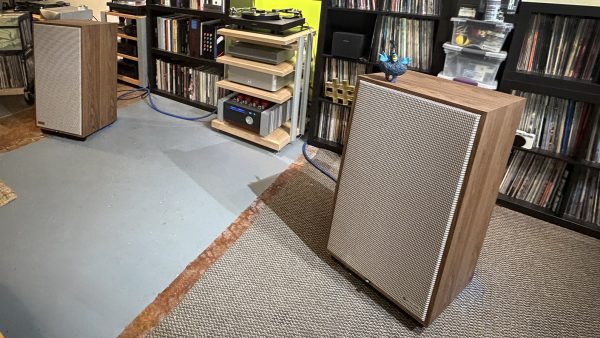
Listening to Tears For Fears’ “Woman in Chains” from the MoFi vinyl remaster through the ØAudio Ymir speakers is an enveloping experience. This exquisitely produced record is a textbook example of pinpoint imaging and immersive soundstaging. Granted, these are the result of decisions made at the mixing board, but when a recording like this is presented with the dynamics, resolution, and tonal clarity the Ymirs provide, it’s the difference between great sound and a lifelike, immersive feeling. This is the heart of what the Ymir delivers. With every kind of music.
If any number of offerings around the $65k/pair asking price from the usual suspects leave you nonplussed, consider the ØAudio Ymir. These gorgeous Norwegian speakers have it all. They deliver great sound, a stunning aesthetic, and relatively high sensitivity (93.5 dB/1 watt).
However, that high sensitivity rating doesn’t tell the whole story.
 Having just spent time with ØAudio’s Frigg 02, I still had that sound fresh in my mind, along with my earlier listen to the Ymir at Axpona this year. As you would expect from a premier speaker manufacturer, the Frigg’s core values come through even more in the Ymir: it plays bigger, louder (and softer), with more depth and resolution. However, the YMIR shares nothing with the other Ø Audio speakers than the design team.
The woofer is so heavy that The Absolute Sound’s Robert Harley almost dropped it when I handed it to him at the Axpona demo. This massive 12-inch driver has a huge magnet assembly and an incredibly stiff basket to house its featherweight carbon fiber composite cone.
Unbox and setup
The entire cabinet, with its wooden enclosure and 10mm stainless-steel front baffle, along with the gorgeous stainless-steel legs, makes for a 265-pound monster. To Ø’s credit, they are carefully and logically packed so that two people can box or unbox them. Fortunately, the Cardas crew was in town, and kindly did the unboxing. Yet on their return, Chris Harr and I had no trouble getting them back into the road cases. This is an often-overlooked aspect of speaker design, and this level of attention to packing nearly always indicates the care that goes into everything else related to the speaker. Yes, they are beautiful.
With so many premium speakers starting to look like anime characters, it’s refreshing to see something as elegant as the Ymir. Available in light oak (our review pair) or dark walnut, they are unobtrusive and understated. Until you turn them on, and turn them up.
We ended up with the Ymir’s about 11 feet apart, with some toe-in, and experimented with that for a few days. Initially, they were toed in a bit more severely, but placing them on the long wall in a 36-foot room, with the luxury of backing up about 13 feet, made it easier to back off the toe-in and bathe in an expansive soundfield. Those with smaller rooms may not have this option, but the big room really makes for big sound.
 The finely threaded stainless feet make it incredibly easy for one person to adjust rake angle. Though the Ymir sounds lovely right out of the box, like the Frigg, it benefits from careful fine-tuning once your pair is broken in and you get comfortable with the sound. ØAudio’s Quad Vertex SoundField waveguide, attached to its proprietary, built-from-the-ground-up 76mm compression driver,, accomplishes two things. First, it has virtually nonexistent distortion. I could never play these speakers loud enough to hear distortion or even the slightest bit of the compression that hits right before distortion becomes an issue.
Second, and perhaps more importantly, this waveguide creates a sound field that doesn’t collapse the minute you get out of the chair. This also translates into listening on the floor, well off axis. Sweet-spot listening is great, but with speakers this special, you’ll want your friends to share the experience. With the Ymir, they won’t all be fighting for the sweet spot. (Maybe that’s why the Ø guys all carry an axe…) Whether you’re sitting at the end of the couch or down on the ground hanging out, the sound stays engaging, with a sense of imaging present.
The rest of the review system consists of the full six-box dCS Varese digital playback system, Pass Labs XSPre 2 preamplifier, Pass XP-17 phono stage, and SME 20 turntable with Hana Umami Red cartridge. Cardas Clear cabling was used throughout for speaker, line-level, and power cords. We also used a wide range of amplifiers to explore possible system synergies.
Amplifier choices
Before moving to the main system, listening begins with the 80-watt-per-channel Pathos INPOL Heritage Mk.II, a $20k-ish integrated that is fully up to the task of not only driving these speakers but also adding resolution and musicality to the program. Ø Audio demonstrated the Ymir at Axpona with Boulder amplification and dCS, proving that while these speakers are efficient, they can also handle the power of a large, well-controlled amp.
However, the Pathos makes an excellent choice for a nice, well-rounded, minimal box-count system, providing a great sonic and financial balance. You can always add that million dollar pair of Goldmund amps when you have extra money. Blast.
The most interesting part of the Ymir is its sensitivity and high resolution, combined with a very natural tonal balance, which makes it a speaker that can play many roles, depending on the amplification you pair it with.
If you listen to smaller-scale music at low to modest volume levels, the Ymir can be paired with an SET amplifier for good results. With the Western Electric 91E (9wpc/300B tubes), the Oilily 211 (12wpc/211 tubes) and the ampsandsound Bryce Monos (15wpc/KT150), the silkiness of a single ended triode through these speakers has a much more romantic capability. If you live on a diet of string quartets and female vocals, the Ymir delivers an incredibly three-dimensional, smooth presentation.
 The amount of bottom-end tautness and punch depends on the amplifier and the interface between it and the speakers. Of the group at our disposal, the Bryce monos were the punchiest, with better bass control, while the 91E was a bit smoother on top but had less low-frequency control. However, that warmth may go further when you’re spinning those Blue Note Tone Poet records and want that smoky, listening-bar vibe. The Oilily is a fun bargain alternative, because it has a bit more power than the 300B and those big tubes really light up the room.
An alternative between the SET and higher-powered tube amplification is a Pass Labs First Watt amplifier. Each model is geared toward a different speaker setup. The current SIT-5 monoblocks deliver 35 watts per channel into 8 ohms and 60 watts into 4, with a very low output impedance. At $11k/pair, this might be the secret sauce for all but those who want to play large-scale rock and EDM at club levels.
The First Watt SIT is a single-ended design that delivers about 98% of the smoothness of the best SET amplifier, with much more grip on the woofers than most small tube amps can muster, plus incredible quiet, and you never need to replace tubes. I have to admit I’m biased toward these amplifiers in this setup.
Note: ØAudio claims a minimum 8-ohm impedance, so if your tube amplifier has a 16-ohm tap, give it a try. You might notice the bass response is a bit more solid than what’s delivered at the 4- or 8-ohm taps. But try everything. You never know where the magic might be.
Next, moving on to the PrimaLuna EVO 400 amplifier, which can deliver 38 watts per channel into 8 ohms in Triode mode, 70 watts in Ultralinear mode, or 140 watts per channel as a monoblock, it’s a great alternative for those who like to rock. Fortunately, the EVO 400s we’d had on long-term loan were still here at the tail end of the review. Bias admitted, this was the bang for the buck system for me. About $12k for a pair of monos delivers a system that will pin your ears back with sheer volume, matched by silky smoothness. The Ymir becomes a different speaker entirely when supplied with 100 watts per channel or more.
Which leads to the Pass XS300 monos with 300 watts per channel in pure class A. Like the Boulder I experienced at Axpona, this delivered everything. I could play any music as loud as I wanted, and the extra dynamic swing from that power brings the Ymirs to a level they don’t quite reach with the small amp. You won’t miss it as much if you don’t hear it, but once you do, you might just want a big amp after all. But remember, quality is key. These speakers are highly resolving,, and you’re much better off running them at a slightly lower volume with a high-quality amp, like the Ymir.
Thanks to their high sensitivity, these speakers can anchor your system with a smaller amplifier and grow as your needs and budget allow. Each time you’ll feel like you have an entirely new system again. This also makes the speaker investment easier to justify as a longer-term commitment.
Further Listening
So many amplifier choices can make the task at hand – listening to the speaker’s character, a little distracting. Regardless of the amplifier you choose, the Ymir’s core competencies remain intact.
Solid bass response. ØAudio claims a LF limit of 26 Hz. We don’t do actual measurements, but even a cursory run of test tunes with a sound level meter makes it easy to see where the low-frequency cutoff occurs. The Ymir is definitely solid down to the 25 Hz region when observed in this way.
However, bass is more than just reproducing the test tones. The Ymir excels at having a low-frequency response, with a high degree of tonal and textural accuracy. While it can reproduce the heaviest notes in your favorite rock and electronic tracks, it’s incredible how it switches up to jazz with an acoustic bass. You can hear every pluck, every bit of finger movement up and down the neck of a standup bass, feeling like your there. Male vocals are equally exciting. Whether you are listening to Johnny Cash, Brad Roberts from the Crash Test Dummies, or Howlin’ Wolf, the body and texture are hypnotizing.
Transitioning to female vocals and more contemporary music puts the tweeter and crossover more in the spotlight, and when this is wrong, you know it instantly. This seamlessness is what separates the pretty good speakers from the amazing speakers.
 As someone who has a bias for full-range ESL speakers because of the coherence they provide, this is where the Ymir really wins my love (for whatever that’s worth to you in the audience). The drivers work so well with the crossover and cabinet that the lack of coloration and the seamlessness of the frequencies produced let you forget about the speaker, in a way few speakers can. So put the Ymir’s in the “amazing” category for me.
I’ve said it many times, “dynamics are the fourth dimension.” The Ymir’s high sensitivity, coupled with its huge maximum power capability, makes for a speaker that feels alive. Drums and percussion sound realistic because they demand so much temporary power. That is why, at the end of the day, I still prefer the Ymir with a big amplifier, as much fun as it is with an SET. However, this is my hot button.
Horn speakers aren’t well known for imaging prowess; yet again the Ymir does a stellar job here, too. Listening to studio recordings full of mixing-board tricks shows off yet another dimension of the Ymir that should illuminate and entertain listeners who enjoy this part of recorded music. Though considerably less expensive, the big Klipschorns don’t image anywhere near as precisely – even from significantly far back, as the Ymir does. Go ahead, listen to Aja, you know you want to.

In the end
As comedian Steve Martin once said, “You all look pretty happy for a bunch of people that are all going to be dead someday.” For now, you can have a pair of Ymir’s and live.
If you’ve been aware of ØAudio’s presence online, on social media, and at hifi shows and dealer events, you know they are full of life, and it shows in the speakers they build. With the ØAudio Ymir, you’re not just getting a pair of speakers; you’re getting life.
Highly recommended, and one my personal favorites, for whatever that is worth to you. If you’re shopping for a speaker in this price category, I suggest checking out ØAudio before you buy one of the usuals from B&W, Wilson, Sonus faber, or Focal. These are new people doing things a new way with excellent results.
This crew is incredibly interesting, and I think you’ll enjoy what they have to offer.
$65,000/pair
oaudio.no (factory)
harmoniadistribution.com (NA Distributor)
Peripherals
Analog Source SME 20 w/Hana Umami Red, Bergmann Thor w/Lyra Helikon SL (modded by Ana Mighty Sound)
Digital Source dCS Varese
Preamplifier Pass Labs XS Pre 2
Phono Pre conrad-johson Classic SE
Amplifier Pass Labs XS300 Monos (and others listed in review)
Cable Cardas Clear
Axe Ace Hardware