A Botique Approach to the Horn Speaker:
$7,990/pair
By Jeff Dorgay
Even unpacking the Shakuto A811b-12s in the garage, the urge to hook them up right away and get some music playing was too hard to resist. Plugged into a vintage Luxman BRID amp (remember those?) using my garage computer’s line out as a source for ROON files, the sound was inviting.
Playing a series of Art of Noise, Infected Mushroom and Kruder & Dorfmeister tracks, it was immediately apparent: they play loud, go deep, and deliver a lovely midrange. They look pretty damn cool doing it too. Enough to attract a couple of neighbors out  for their morning walkies to stop by, take a look, and inquire further. That’s always a good sign. As the speakers got about an hour’s worth of time on them, and it was a sunny day here in the Pacific Northwest, chilling out got the best of me.
I ordered up some Orange Chicken from Panda Express (don’t hate me), and when it arrived, I spent the better part of the day just sitting in the garage listening to the Shakutos and watching the world go by. On many levels, that is the highest compliment I can pay to any speaker – that you want to get into the music and tune the world out. This would only get better with more hours on the clock and more careful setup inside the studio.
In a noisy world of hifi reviews, where YouTubers and reviewers alike are constantly having their minds blown, being gobsmacked, and hearing the most amazing things they’ve ever heard, let’s try to keep it real.
Here’s what I really like about the Shakuto Audio A811b-12 speakers. They are an honest product, delivering great sound at an approachable price, and are hand-built by people who care. They’re also very easy to drive, so you can use a low-power tube system, a low-powered vintage receiver, or even DIY something together that delivers engaging sound. In short, they will be great anchors for a reasonably priced system that will serve you well for a long time.
After spending time with many high-sensitivity speakers from Klipsch, Odeon, Songer, Volti, Zu, and Ø Audio that all offer a great perspective on the concept, I have to say I love the Shakutos enough to purchase a pair for permanent reference.
With Klipsch just introducing their OJAS collab at about ten grand, and of course the mighty K-horn (I have a pair of the current AK7), you might see some visual similarities. Those of you in the audience that are diehard Klipsch fans probably won’t be swayed to investigate something else. That’s ok. Klipsch isn’t going to go out of business because of Shakuto Audio. Think of these as an ARCH motorcycle as opposed to a Harley.
However, if you haven’t decided yet, I can’t suggest these speakers highly enough.
Unboxing
The Shakutos arrive well packed in a massive crate and are easy to unpack. The horns are not attached to the woofer cabinet for additional safety in shipping, and are a work of industrial art.
To be clear, the Shakutos use vintage Altec Lansing 811B cast aluminum horns, with a current compression driver. Shakuto cleans them up and powder coats them to look better than new, retaining the classic feel but with a modern Danish SB Audience driver, which they also source, they deliver a sound that pays homage to the classic design, yet has a current sound.
The crossover is listed at 1,100 Hz, with an 8 ohm impedance spec and sensitivity rating of 97db/1-watt. While everything supplied as-is from the factory is perfectly fine, I’m going to channel my old pal Art Dudley in the future and experiment with my vintage Audio Research active crossover to see if I can get some interesting results. So you know, the entire review has been in the stock configuration, which will probably suit 99.99% of you just fine.
Setup
Once the components were loaded into the studio, the process of attaching and securing the horns begins. I suggest placing the speakers as close to their final position as possible before mounting the horns, so you don’t damage anything. And do NOT lift these by the horns once they are installed.
 You will notice the slotted track where horns attach to the woofer cabinets. Listening began with these about ¾ of their travel forward, but once the speakers had about 100 hours, some fine-tuning takes the Shakutos to another level of clarity.
When you feel the speakers are broken in sufficiently (again about 100 hours–ish), spend a few hours fine-tuning the time alignment between the horn and the woofer. I used some painter’s tape on the cabinet to make subtle, repeatable adjustments. First, mark where you are starting, then gently move that horn all the way back, taking note of what just happened to the sound. Next, move it all the way to the front of its travel.
Once you hear the extremes, move back in small increments from the front until you hear the music lose its pace and integration. Then move back in the opposite direction in smaller increments until you find the spot. It’s not unlike fine-tuning the VTA on a turntable. Pro tip: If you start with the horns at about ¾ of the way towards the front end of the cabinet, you’ll be “pretty good.” But if you want to extract the maximum performance from your speakers, spend an afternoon with this – preferably with some acoustic music. That will make it easier to fine-tune.
 Amplifiers
Where the Klipschorns do not work as well with a low-powered SET amplifier as you might think, especially with a claimed 103db/1-watt sensitivity, the Shakutos are fabulous with low power. This makes them so much easier to get engaging results on a realistic budget.
As I’ve been on a vintage, low-powered receiver kick lately, I began serious listening with an old Sansui 800. It has about 13 watts per channel – more than enough for these speakers, yet plenty of grip on the low end and sweetness on top. While I did most digital listening with the dCS Vivaldi ONE/Apex, to stay in context with this system’s goals, I used a vintage Proceed PDP player and Technics SL-1100 turntable for analog. In addition to the Sansui, a recently re-capped Pioneer SX-535 was a fun swap for the Sansui. Both made great music in a vintage, but not quite tubey way.
But hey, tubes really are the way to roll with these speakers, unless you happen to have a Pass Labs First Watt amp and you don’t want to deal with tubes. We’ll do a long-term follow-up with First Watt, as I have a few flavors of them and that will make for another article. Suffice to say, if you love tube sound and don’t want to roll or source power tubes, a First Watt amp will give you a slice of heaven with the Shakutos.
Tubes, tubes, tubes
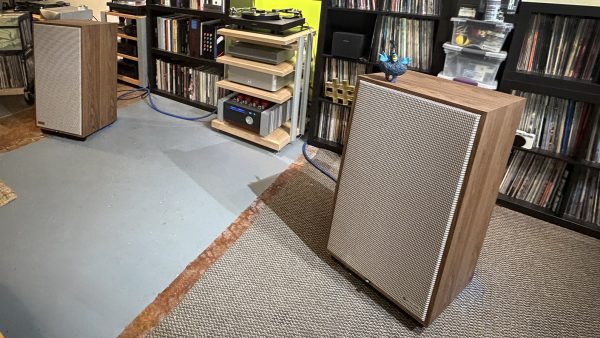
As mentioned earlier, grab your favorite tube amp, a pair of Shakutos, and a Technics turntable, and you’ll feel like you’re in Japan at a Kissa bar. These speakers have such a great mid-century aesthetic; it’s amazing. At 16 inches wide, 18 deep, and 33 tall, they will fit nearly everywhere a pair of Klipshorns or even LaScalas will not.
Best of all, these speakers produce plenty of bass. In our 13 x 19-foot living room, I did not feel the need for a sub, even with the most thumping electronica tracks I could find. After listening to The Art of Noise out in the garage weeks prior, I knew I’d be in good shape with the Shakutos, and there has not been a moment of disappointment. It’s worth mentioning that in the smaller room, having the ability to pull the horns back about an inch and a half made for better integration in a room this size. Bravo, Shakuto, for offering this.
An even bigger surprise was had out in the main room, which is 24 x 36 feet. On the 36-foot wall, with no side wall issues, these speakers really open up and provide a broad, deep soundstage that goes well beyond the speakers. I’m going to call the imaging specific, but not pinpoint. This is not a problem for me as I’m a panel guy, but the additional sock that the Shakutos bring to the presentation is vivid, especially at modest listening levels. Again, that Kissa thing.
With the speakers about 12 feet apart, slightly toed in, and a listening position back about 10 feet, the result is heavenly.
The short answer is these speakers are extremely tube-friendly, regardless of what you have at your disposal. I tried five different variations on the theme. The Western Electric 91E (300B), ampsandsound Bryce Monoblocks (KT120s in SET mode), Oilily A211 Mk.II (211), PrimaLuna EVO100 (EL34s) integrated, and the conrad-johnson CAV60 (EL34s) integrated.
These amplifiers range in price from about $2,000 to $20k. All had their strengths and weaknesses. Overall, the CJ delivered the broadest combination of musicality, imaging, dynamics, and warmth. The ampsandsound Bryce amps presented a bigger image and more warmth, but slightly less dynamic because of lower power. However, in sheer musical involvement, these were my absolute favorite. The PrimaLuna is a great budget integrated that delivers a lot of what makes the CJ so good at a lower price, and you can order one with a very reasonable MM phono built in. Keep this in mind for a minimalist system. This with the Technics and a Shure M97 was pretty rocking indeed.
As you might suspect, the WE amp with their own WE300Bs ended up being the master of midrange magic, and should you be someone who listens to a lot of female vocals and smaller-scale acoustic music, you might want to start with a 300B amp, or perhaps even a 2A3.

My favorite for the coolness factor was the Oilily. While not as sensuous-sounding as the other SETs, it’s not bad, has more oomph in the lowest bass notes, and those big 211 tubes light up the room! Sexy AF. A few listening sessions with the neighbors and the 211s made for some great evenings with a few drinks. Plus, we haven’t had the Oilily long enough to tube-roll that baby to perfection.
Final notes on sound
Overall, the Shakutos have a very music-friendly, inviting sound. The crossover design and mating of the drivers is excellent – you can put any fears about a 1kHz crossover to rest. Vocals are natural, and there is no sense of harshness anywhere.
Much like the Voltis we reviewed last year, Shakuto does an excellent job of producing a horn speaker that doesn’t have a shouty presentation. That said, it doesn’t hurt to get back 10 to 12 feet for maximum driver integration and the biggest sonic footprint with the widest sweet spot. In the big room, having the couch 10 feet back gave the largest stereo image for a single person, and moving back to about 13 feet gave the best presentation for a full couch of three people, with a slightly smaller overall feel. Do you want to be selfish or share the love?
Of course, you can expect a horn system to be dynamic, and the Shakutos do not disappoint. When playing heavier rock and electronic music, they deliver the goods, yet these speakers come alive with the SET amplifiers and your favorite 50s/60s jazz pressings. Miles and Coltrane are as fun as they can get, with horns, electric bass, and drums hitting hard.
70s rock via reel-to-reel tape, thanks to Rhino, is also an enveloping experience. The vocals from the first, self-titled Crosby, Stills, and Nash album feels like it’s 1970 again—Ditto for Joni Mitchell’s Blue. If your record collection leans more toward this kind of music, the Shakutos will serve you incredibly well.
As I mentioned earlier, these speakers offer extended and satisfying bass response – both in terms of output and detail. The chosen driver has plenty of grunt, integrates excellently with the horn, and delivers the goods. The urge to keep revisiting classic rock and old-school hip hop maxi singles just shows how inviting the Shakuto is. Yet spinning Madonna’s latest shows these speakers can dig deep.
The biggest surprise is how resolving, yet smooth, the Shakuto horn tweeter is. While so many are at the altar of OJAS, I suggest you give the crew from San Diego some love. If you managed to get a pair at the introductory price of $5,990, you got the audio deal of a lifetime. At the current price of $7,900 a pair, I still feel they are one of the best values on the market. Much as I wanted to award them an Exceptional Value Award – I think they are worth even more, so we are very happy to give the Shakuto A811b-12 one of our Product of the Year awards.
shakutoaudio.com/models