PART ONE
The coolest thing about a pair of Klipschorn speakers is the balance of love, passion, and engineering that has gone into refining an original concept over nearly 80 years. Even though the even larger Jubilee is the flagship, the 2nd-from-the-top KHorn remains a destination speaker for music lovers around the globe.
It doesn’t take much time listening to these mighty horn speakers to see why. If you’ve never heard them, it’s a pretty exciting window into reproducing music.
Roy Delgado, chief engineer at Klipsch, has been there for more than half of the company’s history, working side by side as an apprentice to the legendary Paul Klipsch for 16 of those years. He was kind enough to share many great stories about his time at Klipsch, and about the design and updates that made this speaker what it is today.
Back when I was getting thrown out of the big listening room at Flanner’s Audio in Milwaukee, Wisconsin (they were Flanner & Hafsoos in the Mayfair shopping mall back then) for wanting to play Pink Floyd (Meddle, not DSOM, ha!) I think a pair of KHorns was about $3,000 – crazy money considering my parents’ new Buick was $3,995. Even a snooty salesperson would not dampen my enthusiasm for the big KHorn, but it took a while for them to finally get here!
Ironically, this review was just run in issue 125 of TONE, and I got a very nice note from Mike Dyer, who let me know that he used to work at Flanner & Hafsoos back in the day. Music brings us all together. He was probably the guy throwing me out of the Klipsch room! Ha.
Now that we live in a world with (mostly disappointing) 850-thousand-dollar speakers, a pair of KHorns has to be one of the best deals in audio. They are still made by hand in Hope, Arkansas. You could pay more than the $18,999.98 MSRP (without active crossover) for a power cord in 2025. I know what I’d rather have.
Another thing that’s changed in a major way since the late 70s, when I first experienced these speakers. Things have gotten larger and smaller in a major way. Even when TONE started twenty-plus years ago, a 260-pound speaker was on the big-ish side. These days, not so much. Fortunately, my studio is built upon a 13-inch-thick concrete slab. And, on the other 24-foot wall, a 1,200-pound pair of Clarysis Auditorium Plus speakers flanked by another 600 pounds of REL subwoofers and almost 700 pounds of Pass monoblocks sit.
Getting down to busines
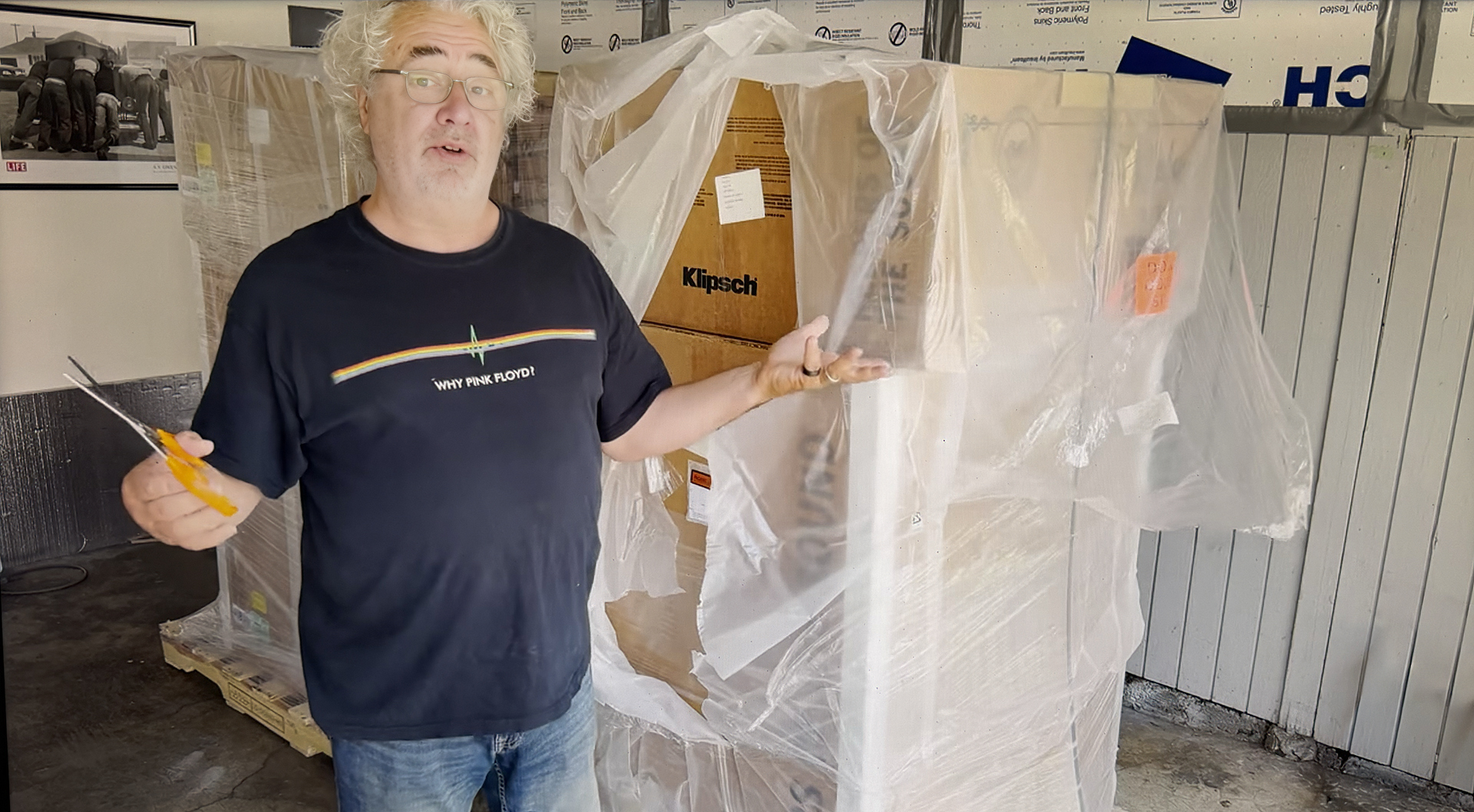
All that said, unpacking a couple of 260-pound speakers – easy. Chris drops by to give me a hand, and now that we’ve done this, it’s a lot easier. I could set yours up a lot faster now that I’ve done it. Buy the beer and call me. Definitely get a friend to help you with these unless you are super buff. Both cabinets are fairly bulky, and you don’t want to damage that gorgeous finish! Better yet, buy your KHorns from an authorized Heritage dealer. They will assist with setup.
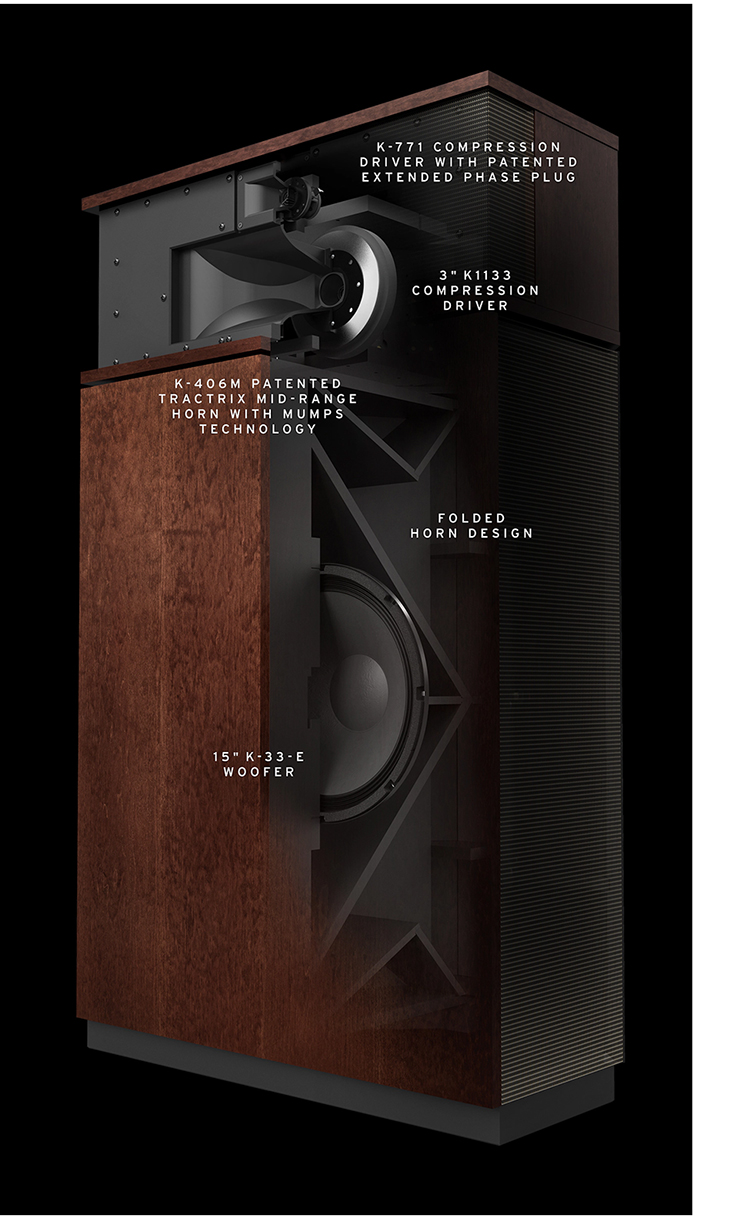
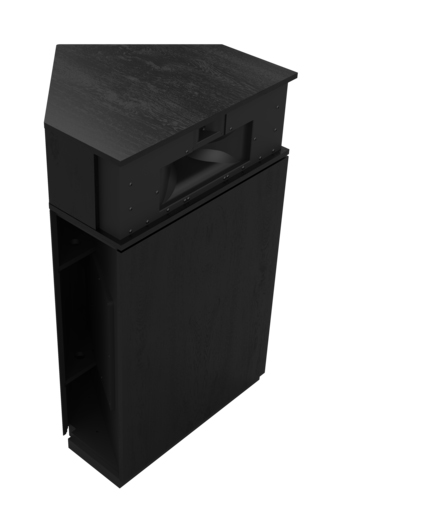
Fortunately, the AK7 is shipped as a two-piece speaker, with the horn mid and tweeter in the top cabinet and the woofer in the bottom cabinet. All KHorns feature a book-matched finish in one of three finishes: Black Ash, American Walnut, or American Auburn – the color of the review pair. They also feature a 10-year warranty.
We’re showing you the cutaway from the Klipsch site, so you can see exactly how this speaker in constructed. The recent K-771 compression driver used as the tweeter is crossed over from the new K-1133 compression midrange driver – now an inch larger at 3 inches in diameter, at 3,900 Hz, and then crossed over to the 15” woofer at 380Hz.
With a couple of days of break-in listening in the rear-view mirror, it was time to get serious. What better track than Jon Astley’s “Jane’s Getting Serious” to get the party started? This ’80s classic presents a massive, ping-pong stereo image, highlighting one of the K-horns biggest features. These babies throw a huge stereo image. Playing on the 24-foot wall of my 24 x 36-foot listening room reinforces one of my (very) few rules of hi-fi: Nothing really rocks like big speakers in a big room. And that’s coming from a guy with not one, but two pairs of Quads and a pair of LS3/5a’s. Yeah, you can keep those small-ish speakers. I can’t play Kiss Alive! on a pair of mini monitors.
Which happens to be the next album on the list. Thanks to Bernie Grundman’s recent remaster of this legendary live album, much of the original’s lost dynamics are now present. Thanks to the PrimaLuna EVO400 monoblocks with 140 watts per channel of tube power, the KHorns actually achieve concert-level volume in my listening room. (Osha advises against listening at this level for more than a few minutes, so you have been warned.)
As I like to say, “Dynamics are the fourth dimension…” Contrary to popular belief, this isn’t just about delivering ultra-high volumes. At extremely low listening levels, the KHorns come alive, reproducing the most delicate, nuanced sounds as well. Enjoying “Tea in the Sahara” from the Police’s Synchronicity is fantastic. There’s a lot of air in this track, and even at a modest, conversational level, these speakers are musically involving. Not all speakers can deliver this. Forgetaboutit on my LS3/5a’s, but in all fairness, it is something the Quads do well.
Nothing but fun
Sure, those speakers in a small to medium room have their own magic – that’s why I have em, but the Klipsch have their own magic. As I re-discover, repeatedly. After spending time with the Cornwall and the LaScala – both excellent in their own right- the big K horn is an exciting speaker. The current flagship, the Jubilee, even more, but that’s another review.
On one level, we might have titled this review – “now they have bass.” That’s only part of the story. The Klipschorn has always been a speaker designed for corner placement, but as previous generations of the speaker always had an open back, literally using your room’s walls as the rear of the baffle, this new version offers more options.
Older versions of the KHorn leave the back of the bass cabinet open, and unless you can put them exactly up against the wall, more often than not, the low-end performance is subpar. It’s not the speaker’s fault. The current speaker has a LF spec of 34Hz, and test tones confirm this.
Relatively quick setup
Past experience with this approach has been marginal, because you never quite know what you’re backing up against. If you’ve got solid walls, this still means a bit of tuning to get it right. The closed back definitely helps, but after a few days of playing Tetris with 200-plus-pound speakers, a solid corner still offers the most solid bass response, the smoothest bass-to-mid-bass transitions, and an enormous soundstage. But it’s bigger, better, and a lot easier to get there. Fortunately, the drywall in my studio is glued and screwed down, so I’m sure this helps. I’d suggest starting with your KHorns in the corner about 2-3 inches from the walls and adjust from there. This will get you to the fun zone a lot quicker.
You might think that having a pair of speakers 24 feet apart is crazy talk, yet with the big Ks angled in to the center of the room at a 45 degree angle, the optimum listening spot is about 20 feet back, which leads to another aspect of people who have had a less than awesome experience with the Klipschorn, or for that matter any horn speaker.
It’s critical to be able to get back far enough for those drivers to integrate. Where normal, cone or planar speakers can sound more like being inside a giant set of headphones, sitting too close to horn speakers just sounds disjointed. If you don’t have a medium-to-large room, I’d tell you to buy LaScalas instead.
Just to explore, placing the KHorns out in the room as you might with a box speaker is not the way to roll. Stick with tradition and put them in the corner!
Another interesting aspect of the KHorns, for audiophiles loving to display a massive rack of gear between the speakers: because the big horns project their stereo image out about 15-20 feet in the room, imaging really isn’t affected the way it is with a pair of panels or minimonitors.
Finally, give your KHorns a little time to break in and unwind after being on a freight truck for a while. Because a big part of the Klipsch design is to utilize drivers having short excursion, these drivers do take some time to mechanically stabilize. I noticed that about 100-ish hours of playing them at a fairly high level had them sounding their best. They were a little flat right out of the box.
Improvements to the breed
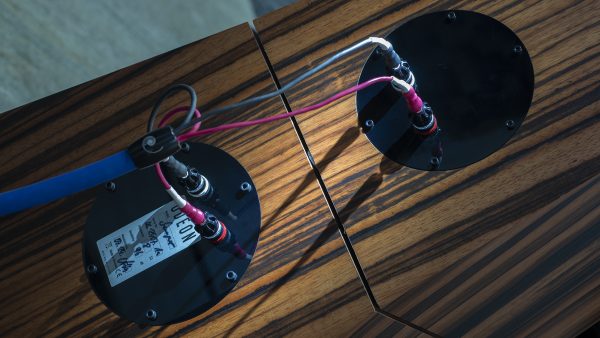
Thanks to the high sensitivity of these speakers, you can certainly get by with a couple of watts per channel of tube power, and on one level, this speaker is perfectly suited to a low-power SET. When you peek behind the magnetically attached panels for speaker hook-up and crossover, it’s easy to see into the Midrange/Tweeter cabinet and appreciate the high-quality crossover components now used in the passive network. Even though you can use the active crossover, it’s easier than ever before to bi or tri-wire them in passive mode.
Years ago, when I borrowed (ha!) a set of late 70s version KHorns from Echo Audio, when I was contemplating a purchase, I noticed that though these speakers were still extremely sensitive, due to the nature of the earlier crossover, they weren’t the match with a 300B or 2A3 amp that I was hoping for. The first couple of watts got lost in the network, and this speaker really needed some power behind it to play.
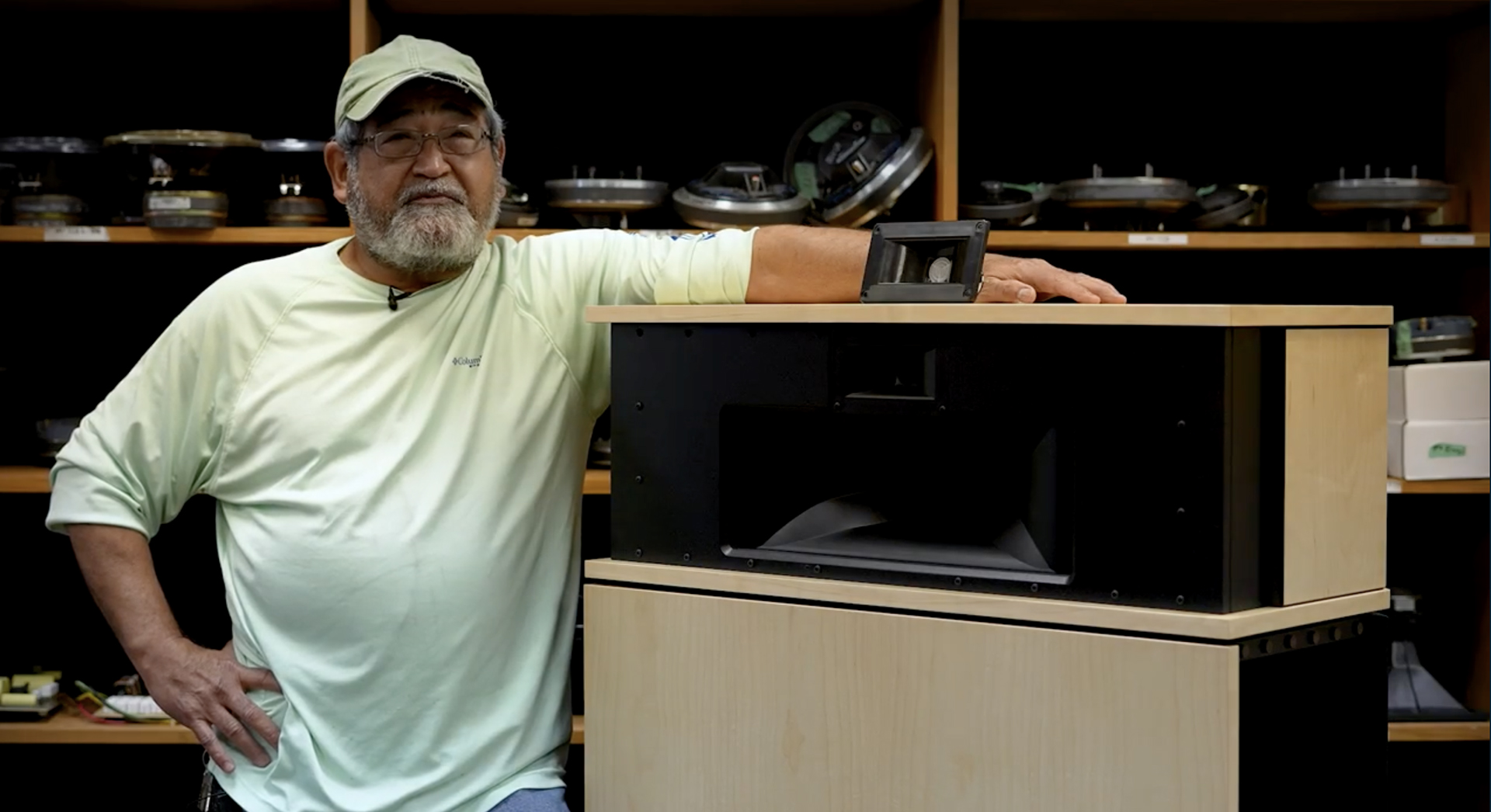
All of that has been addressed in the modern Khorn, along with updated Tractrix horns for the tweeter and midrange. After a great chat with Roy Delgado, the man at Klipsch who worked with the legendary Paul Klipsch for years, I found out why so many improvements have come out at a measured pace.
Delgado weaves an incredible story about how he came to Klipsch straight from college, with his engineering degree, not really even knowing who Paul Klipsch was. The best part of this story is that he jumped in with no preconceived notion as to how things should be. He said that Mr. Klipsch always asked for his input, and according to Delgado, always had a plan for the development of their speakers. He said Klipsch always said that improvements would be made “when it was time,” and stuck to it. Incidentally, the active crossover was always part of the plan.
Mr. Delgado also tells me with a huge smile on his face about when he heard music on a set of KHorns for the first time at the Klipsch factory and said, “That’s how I’ve always wanted music to sound.” Passion like this is tough to ignore.
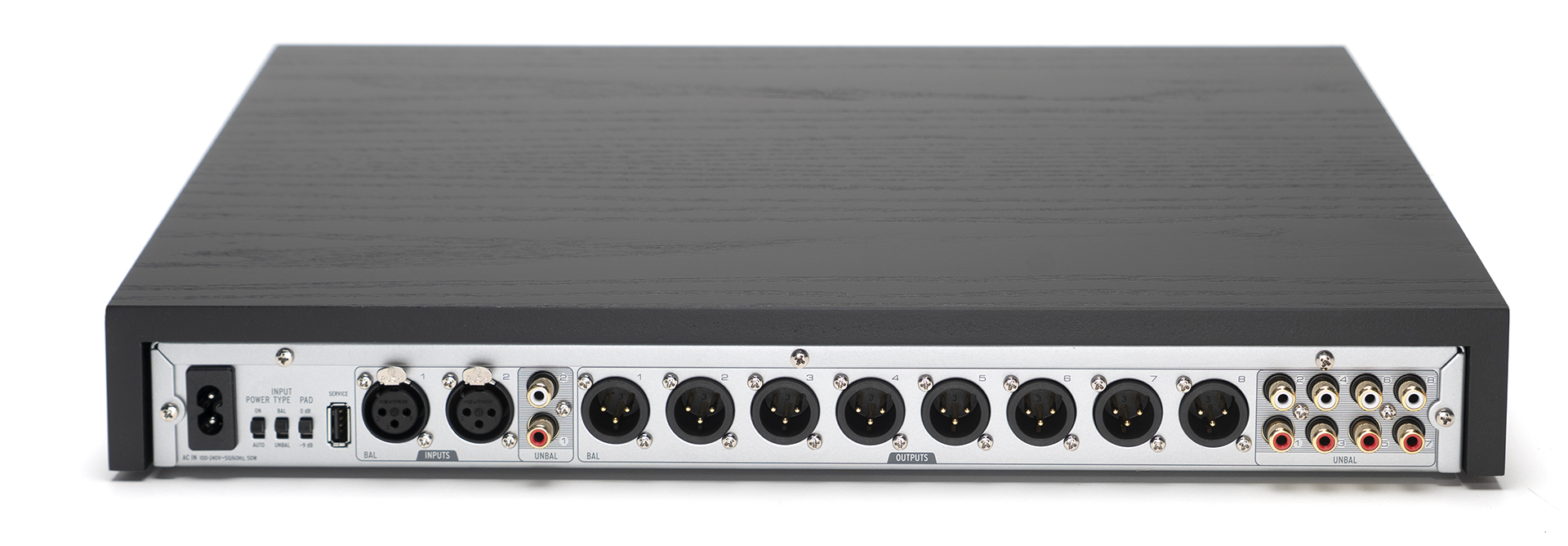
Delgado also explains that the major improvement from the active crossover is the ultimate time alignment of the drivers. He tells me, “I made it a point to make the passive version the best I could.” But knowing there is much more to extract from these speakers is exciting. The active crossover is $3,499 and requires two additional stereo amplifiers and additional cables.
Another thing Delgado makes clear, and I really appreciate is that this is a speaker that has been fine-tuned, by ear, to sound the way it does. Both Mr. Klipsch and Mr. Delgado were in perfect agreement that the end result has to sound musically correct, or nothing else matters.
In the day of perhaps too much emphasis put on measurements, it can be easy to get carried away with the lab results. That’s the main reason these speakers have such a great tonal balance – and there really isn’t a measurement for that.
Amplifier choices
Because of my past experience with older KHorns, a wide range of amplification was tried to see where the sweet spot, if any, is. These speakers are resolving enough to reveal the character of whatever you plug them into, but they are particularly (by nature) sensitive to dynamics and noise level. The Finale 300B amplifier just wasn’t quiet enough for small-scale classical and acoustic music for me, yet the ampsandsound Bryce monos (12wpc SET using KT 150s in triode mode) were a home run.
Where the PrimaLuna EVO 100 had more than enough power, the additional resolution provided by the EVO400 would be my choice here.
CH Precision’s i1 integrated that was parked here for part of the review is also intriguing because of the incredible control and enormous dynamic range – though you will be taken to the ER with bleeding ears before you use even a fraction of it’s 200 watts per channel! Ditto for my main reference, the PassLabs XS300 Monos. That said, I found some major magic with the Pass XA30.8 amplifier, possessing much of the mighty XS300s tonality in a much more reasonably sized (and priced) package.
However, (and this is very personal) the last bit of magic for me comes with a pair of Pass Labs First Watt SIT-5 monoblocks, which makes the heavens part. None of the other choices were wrong, but discovering the perfect amp for you will be a fun part of your journey. As I finish this review, the Pathos InPol2 Mk.II Heritage integrated has just arrived, and this also looks to be a major winner.
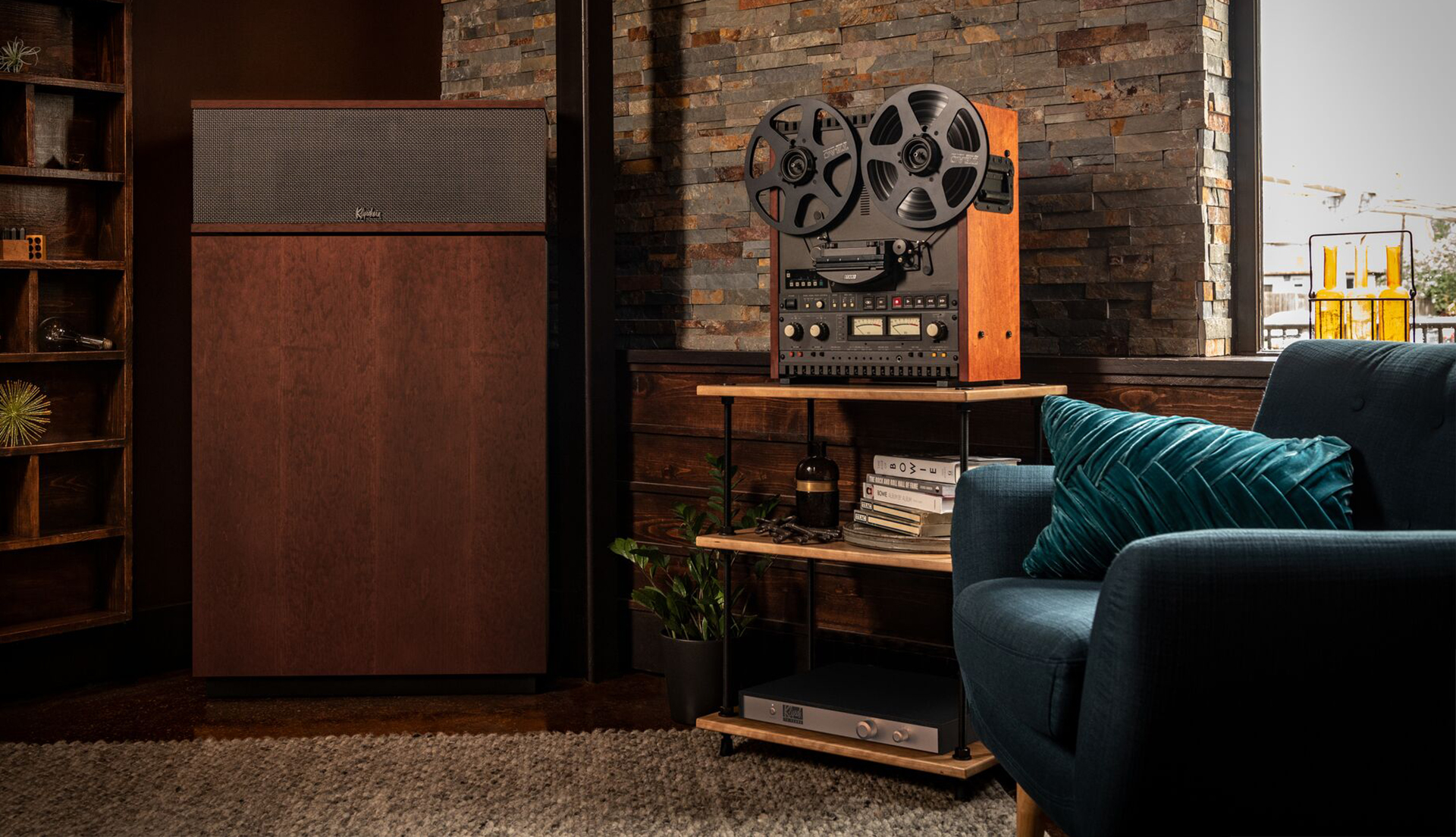
I love the attached picture, courtesy of the Klipsch press archive, because I’m in the process of taking delivery on an Otari open reel deck just like the one in the picture. I plan on playing a lot of tape through the Klipschorns.
More listening
To this point, if you have the room to properly incorporate a pair of KHorns, it’s an exciting speaker. The dynamics are one thing, but the large overall presentation is another. Where my Magnepans present a large soundfield but don’t always scale with the size of the instrument being portrayed, this is one of the KHorn’s major strengths. Small instruments sound the correct size, and vice versa.
Another favorite acoustic recording is the famous Friday Night in San Francisco, along with the recently released Saturday Night in San Francisco, from Al DiMeola, Paco Lucia, and John McLaughlin. Whether this record is your jam or not, you can stream them both and listen to the way the three acoustic guitars come in and out of the soundfield, just as they would if you were sitting in about the 10th row of the Warfield Theater in San Francisco when it was recorded.
An off-the-beaten-path reference track is John Klemmer’s “Cry,” from the album of the same name. Playing this at a level that is beyond prudence turns Klemmer’s echoplex-processed sax into a fifty-foot-tall sax that could take Godzilla out. Who knew? Man, these speakers are fun. If dynamics are the fourth dimension, fun is the fifth dimension – and it’s something high-end audio seriously lacks. The KHorns put fun back on the menu?
As the late Frank Zappa said, “Isn’t that what life’s all about?”
More in store
You’ll notice this review is labeled “Part One.” Now that the AK7 version of the Klipschorn is available with a three-way external DSP crossover network, bringing two more stereo power amplifiers, and the associated cables, makes a $20,000 pair of Klipschorns a more expensive and complicated proposition. So much so that the active version truly deserves its own review.
Mr. Delgado will give me more insight into fine-tuning the crossover, and I’ve added a third PrimaLuna EVO power amplifier to the pair I already own, so we can at least start with three identical amps. Of course, trying some variations on the theme will also be investigated.
For now, it’s the end of the year, and wrapping it up with the KHorns here is a tremendous honor. In addition to awarding the AK7 Klipschorns one of our three Masterpiece Awards for the year, I’m keeping the review pair for permanent reference on the opposite wall of my Clarisys Auditorium Plus speakers. We only give this to manufacturers that have been delivering excellence for a long time, and this fine American company definitely fits that requirement.
It’s part love, part history, and the fact that these speakers do something very special, and something, much like my Quads, that no other speaker does, and if you want this experience, there’s no other way to get it. As someone who’s wanted a pair of these since they were 14 years old, it’s truly an honor to finally have a pair. I can’t wait to explore the active options. Stay tuned.
$18,999.98/pair (without active crossover)
Peripherals
Analog Source SME 20 turntable w/Hana Umami Red Cartridge
Phono Pre Pass Labs XP-27
Digital Source dCS Vivaldi ONE, dCS Varese
Preamplifier Pass Labs XS Pre
Power Amplifier Pass Labs First Watt SIT-5 Monos
Cable Cardas Clear and Clear Beyond (power, interconnect and speaker)