The temptation with British monitors is always to start the evaluation off with some Beatles, Stones, and Yardbirds, with maybe a little early Clash or Elvis Costello – just because, but this time, a great suggestion from Chris Harr was to crank some techno.
Why not? Charlotte de Witte’s “Last Paradise” is the first track played with the Castle Windsor Duke, and it’s impressive. This two-way design combines an 8-inch woofer and a 1.1-inch textile dome tweeter in a relatively compact 18.5 x 11 x 12.25(deep) cabinet. Their website does not list a weight spec, but they feel like about 25-ish pounds each.
For those wanting to geek out on the hardcore specs, please click here to go to the Castle website:
These are damn gorgeous speakers. Unboxing the Windsor Dukes, with their dark mahogany finish and shaded edges, is such a nice change from walnut and cherry that all my other fave Brit speakers are coming in. Castle says that all their veneers are book-matched, with no two pairs exactly the same. There’s something about the shading that reminds me of a vintage guitar, or a Rothko painting. Lovely.
A bit of background
Castle has been around for quite some time in the UK and the rest of the world, but has just recently been imported by MoFi Distribution. So when their PR guy, Lionel Goodfield, asked if he could send a pair for review, it made for an exciting trifecta of British speakers. The minute I mentioned this to a few audiophile buddies, the first question was “How do they compare to the Harbeths and the Wharfedales?” All before they were even out of the box!
The timing couldn’t be better, because we have a pair of Harbeth Monitor 40.5s and the Wharfedale Dovedales, just ready to head home. It was easy to make some general comparisons in voicing and execution.
To make the listening even more interesting, the Quad 33 preamplifier and 303 power amplifier are also here, with a clean pair of Quad 63 speakers. I’ve also picked up some 57s, but they need a major overhaul. All I need now is an E-Type Jag or a vintage Bentley, and I’m totally serving the King. But with a pair of Mini Coopers in the driveway and a couple of unruly English Bull Terriers, I feel pretty loyal to King and country at this point.
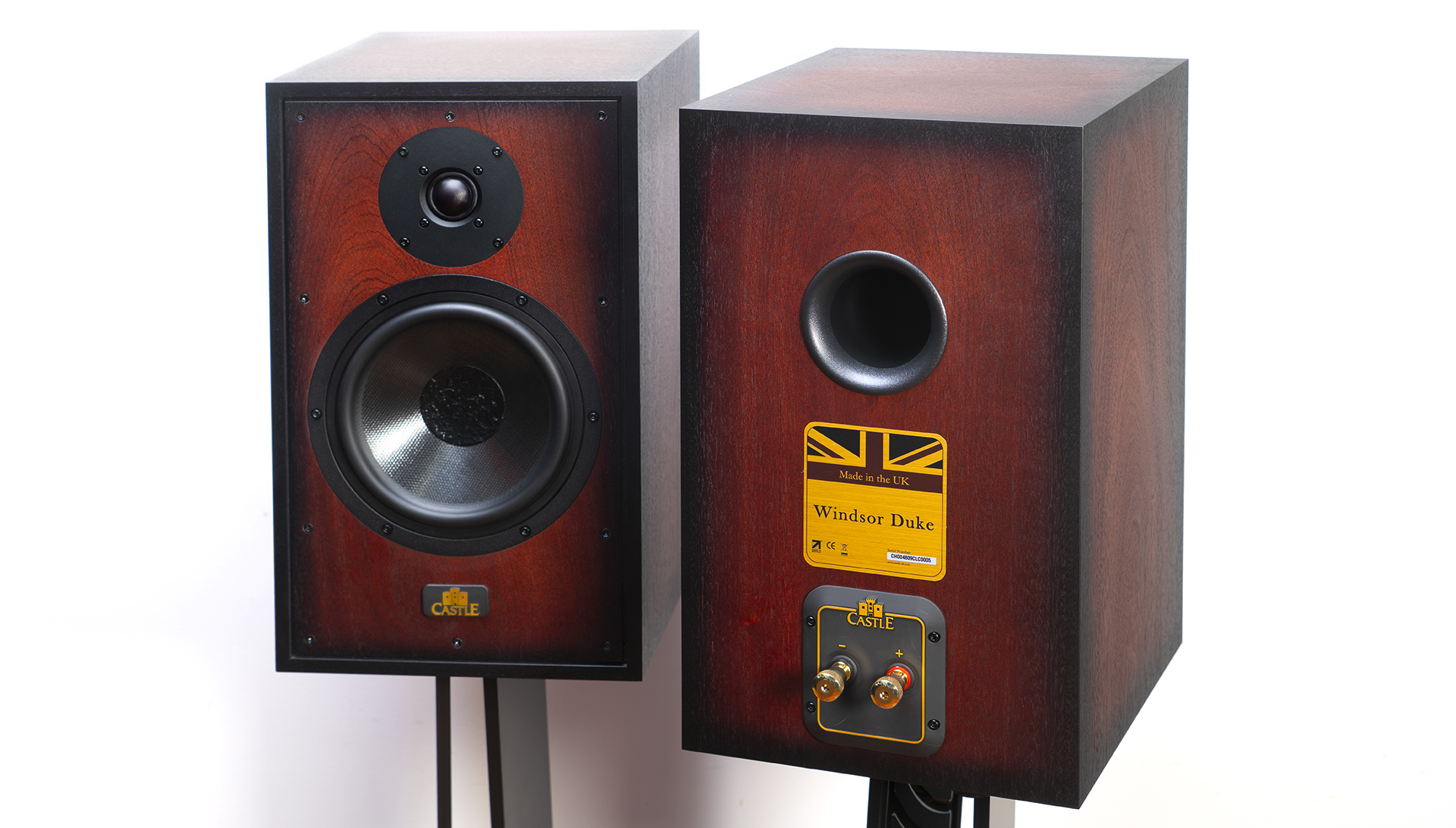
BBC licensees or not (the Castles are not), there’s something about most British loudspeakers in the way they always do a great job with the midrange – and I’m not just talking the female voice. If you’ve been to the UK much, you’ll notice that the average flat there is usually less spacious than the average McMansion in Scottsdale. I suspect this is why many smaller British speakers are voiced the way they are.
While Castle is based in the UK, it is now part of the IAG group, which is responsible for Quad, Wharfedale, and Luxman – these speakers are built in Cambridgeshire, UK. Again, these speakers are beautifully built, both physically and sonically.
The system
With a sensitivity spec of 90 dB/1 watt, they do not require massive power to make music and, from my tests, work well with both tube and solid-state gear. Trying to keep things in perspective, a Rega P6 with a Rega MC cartridge was used as an analog source, and my Naim CD5-iS CD player, along with the HiFi Rose RS250A streaming DAC, were digital sources. As mentioned, the Quad 33 preamplifier and 303 power amplifier, a PrimaLuna EVO200 integrated, and Canor Virtus I2 integrated were used to drive the speakers.
A complete loom of WireWorld Oasis signal cables ties everything together, along with the IsoTek V5 Aquarius power conditioner, making the Windsor Dukes a perfect anchor for a $10k-$15k system, perhaps a little more.
 Room, stands, and setup
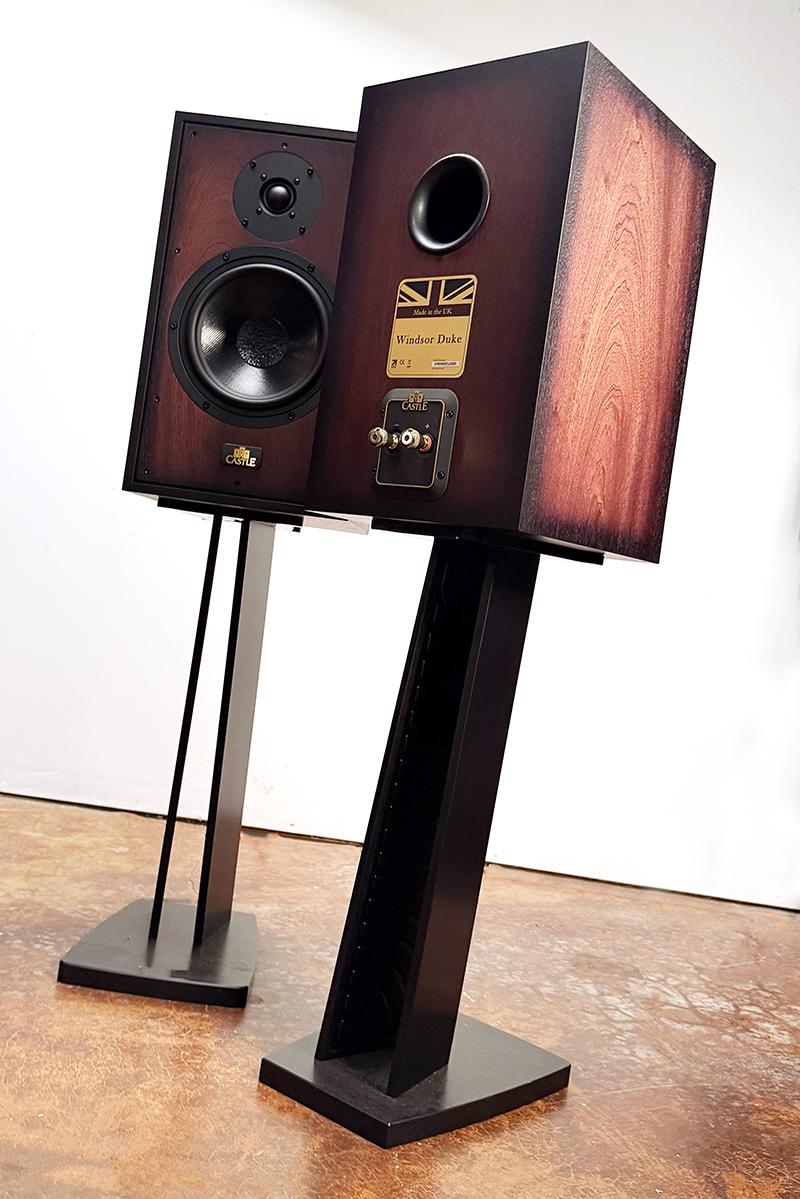
About 100 hours of break-in listening were done in my main room, which is 24 x 36 feet, on the 24-foot wall. The speakers were set up on the supplied stands about 10 feet apart, and 4 feet from the rear wall, with the listening position about 8 feet back.
Even driving this much room volume, the Windsor Dukes put on a great show, delivering excellent low end and a spacious presentation. It did not take terribly long to get them set up and sounding great. I must admit a real bias toward two-way monitors with soft-dome tweeters. I expected these speakers to sound great, and I was not disappointed in the least.
Yet, sacrificing a bit of the vast soundstage these small speakers can deliver in the big room, moving them to my 13 x 18-foot living room makes for a much more intimate perspective. And, the smaller room allows closer placement to the walls. When working with a smaller room, you will need more setup time to find the sweet spot that delivers just the right balance between maximum bass output and minimum upper-bass cloudiness. This will vary depending on what you choose for electronics and your specific preferences.
More listening
While the Windsor Dukes probably produce a more natural, tonally accurate sound with the solid-state Quad amplification or my HiFi Rose integrated, which is Class D, I thoroughly enjoyed the warmer sound of the PrimaLuna amp with these speakers in this room. That may be too much of a good thing for you. Either produce excellent results.
Because these speakers worked so well in my living room, they made for very long listening sessions, and thanks to their openness, didn’t really require turning the volume control up terribly far to be engaged. Castle lists a maximum SPL at 95dB, and I never got terribly close to this, other than to probe where the limit was. With the Rose amp at 200 watts per channel, the Castles don’t clip as much as they flatten out at high volume. I suspect that pushed slightly harder, they will clip, but that’s how tweeters get blown, and out of respect to the manufacturer, none of that monkey business was going on.
Besides, these speakers are so lovely to listen to at low to moderate volume, so why bother? Don’t laugh. Many well-known audiophile speakers can’t play softly, so this is not a knock on the Castle speakers.
Castle lists 52 Hz as the -3 dB point and 39 Hz as the -6 dB point. In a small room with small speakers, room gain is always an asset. Playing test tones reveals solid output to about 40-45 Hz in this room. Playing digital files and using Roon’s parametric EQ function to provide a gentle bump in the overall frequency response at 35 Hz extends this even more.
Should you choose to take this path, be very gentle with the volume control, as cranking the hell out of the speakers adjusted this way could damage the woofer. But hey, think of it as an “audiophile” loudness button. Or add a small sub. But that’s another story. In a small to medium room, don’t feel like a subwoofer is necessary to get great sound with the Windsor Dukes. (Reviewer bias #2: I have REL six-packs in two of my systems, so I’m up for a sub with anything.) Putting the objective hat back on, you’ll be just fine.
Starting here, playing a long playlist of Jean Michel-Jarre tracks from the early 80s to now is punchy, engaging, and just plain fun. The Castle tweeter resolves enough detail to provide pinpoint imaging, yet is never fatiguing, and the 8-inch woofers give great sock.
Listening to a handful of female and male vocal tracks shows what a nice job the Castle engineers have done in matching the drivers and implementing the crossover. As much fun as an excellent two-way is, they can really fall flat (pun intended) if not done right. When that happens, you’ll notice that some tracks sound amazing, while others really suck. To be more British and polite, my experience with small-ish two-way speakers is that when they have a less-than-awesome crossover network, they favor reproducing the male or female voice in a more lifelike way, and the other voice not so much.
Again, the Windsor Dukes pass with flying colors. Whether I was listening to Springsteen or Patti Smith (I know you have your favorites here), both sound believable. Job well done.
The only area in which the Dukes lack somewhat is in playing heavy music louder than you probably should. But that’s not terribly polite, is it? This isn’t so much the speaker’s fault; it’s just that one 8-inch woofer in a small cabinet can only move so much air. And if you want to listen to a musical diet more Slayer-like, you’re going to choose a different speaker in the first place.
Me, I’ll take the refinement any day.
A brief comparison
Comparing these to the $24k Harbeth 40.5XD isn’t fair in the ultimate sense, but I’ve spent enough time with Harbeth to know the brand and its voice. And that’s what happened to be here. I’ve also owned the Compact 7 and Monitor 30, both of which are closer in price to these. But the Harbeth voice is just that. A BBC licensee, they stick closer to the heavy emphasis on the midrange and vocals.
The Wharfedales (both the Dovedale and Super Linton) are slightly more crisp in the upper range, and while a bit punchier, not as refined overall. Again, all of these are great speakers in their own right, but it depends on which flavor is the one that will make you the happiest in the long term.
If these are what you are looking for, I think you’ll be pleased with a pair. If I didn’t review gear for a living and need that big room, I could put a pair of these and a nice tube amp in my little living room and live happily ever after. Perhaps you can as well.
Highly recommended.